Uncategorized
- As below, Haley Barbour’s dreamy nostalgia for pre-civil rights Mississippi is not “false nostalgia,” but it is a rather insidious false memory–the kind of misunderstanding of history that should probably bar one from becoming a serious presidential candidate, but probably won’t. (An editorial in the Times calls it “the faulty memory all too common among those who stood on the sidelines during one of the greatest social upheavals in history.”) It is kind of amazing to watch as Barbour realizes that he shouldn’t admit to “remembering” things this way, and recasting the era as “difficult and painful” where he’d just claimed, “I just don’t remember it as being that bad.”
“Memory has long been the mutable clay of the South, changing the meaning of the Civil War and now the civil-rights era,” the editorial concludes. “But the memory of Mr. Barbour’s personal history will not soon fade.” Or will it?
- I’m not much of a Weezer fan, but the fixation on their early output versus the band’s historic disdain for it–and their recent realization that it’s better if they just embrace it–is kind of interesting. Vulture and the Times report from the band’s current Memories Tour. Of the “alt-rock time machine, Jon Pareles writes, “For the grown-up Weezer, the boldness and fragility, the instability and impulsiveness of ‘Pinkerton’ are now memories. Getting ‘back there’ would be a feat.” Amos Barshad’s piece is headlined “Weezer Is Excellent at Pretending Like It’s 1994.”
- Predictable, yes, but I will probably be seeing this:
2010: The Year of 90s Nostalgia, possibly, maybe?
At The Awl, Josh Kurp writes about what VH1’s shows “I Love the 80s” and “I Love the 90s” did for our memories of those decades—basically, he argues, they undermined and falsified and replaced the truth of what we actually experienced. Revisiting them recently, he also discovered that the shows had less actual content than he thought they did: [T]he talking heads aren’t so much telling jokes as they are explaining the film/show/album/whatever, and then either singing or quoting from the material. There are virtually no jokes; the show is simply for people who say, ‘Hey, I remember that!’”
I didn’t remember Tron, because I’d never seen it. But I felt like I did. Likewise, I spoke about ‘Til Tuesday as if I had heard “Voices Carry” constantly on the radio in 1985, which I did not. My friends do the same thing, for things for which they weren’t actually alive—and it’s not like we’re talking about the Beatles here, we’re talking about MTV VJs and Pound Puppies. Our memories of things we couldn’t possibly remember were brought to us by VH1, and they’ve stuck.
His take on how those shows served as bizarre kinds of backgrounders on the relics of one’s own generation is pretty spot on, but I don’t think nostalgia is “false” just because it’s directed at a movie you haven’t actually seen. A movie couched in a particular time—sure, like Tron, which I haven’t seen either—is rarely just about what’s actually playing out on the screen. The memory of it is about everything surrounding it, and that’s as much what VH1’s joking decade experts are riffing on as anything else. Secondhand nostalgia isn’t necessarily any more “false” that genuine nostalgia—whatever that is. The slipperiness and uncertainty of memories has everything to do with what nostalgia is, and it’s part of why people get so defensive about it in the first place.
Meanwhile, at Capital Gillian Reagan declares 2010 “The Year of 90s Nostalgia,” full of reunions of 90s bands, a few zines being published, vintage glasses, lots of plaid, beards, awfully familiar political struggles, 90’s-centric Tumblrs and of course, Tavi Gevinson.
“Roughly speaking, the 1970s had its ’50s obsession, the 1980s had its ’60s, the 1990s had its ’70s, and the 2000s had its ’80s,” she writes. “Our nostalgia is right on schedule.” Her verdict is more positive and hopeful than Kurp’s: “It is easy to pine for the past, and ignore its ugly chapters, instead of figuring out how to make a future in which we want to feel present. The fear of repeating ourselves is just like nostalgia itself: cyclical and universal.”

paint’s peeling
Some repairs to the bathroom revealed these cross-sections of the many, many layers of paint that have been applied to the walls over the years. I think they’re kind of beautiful.

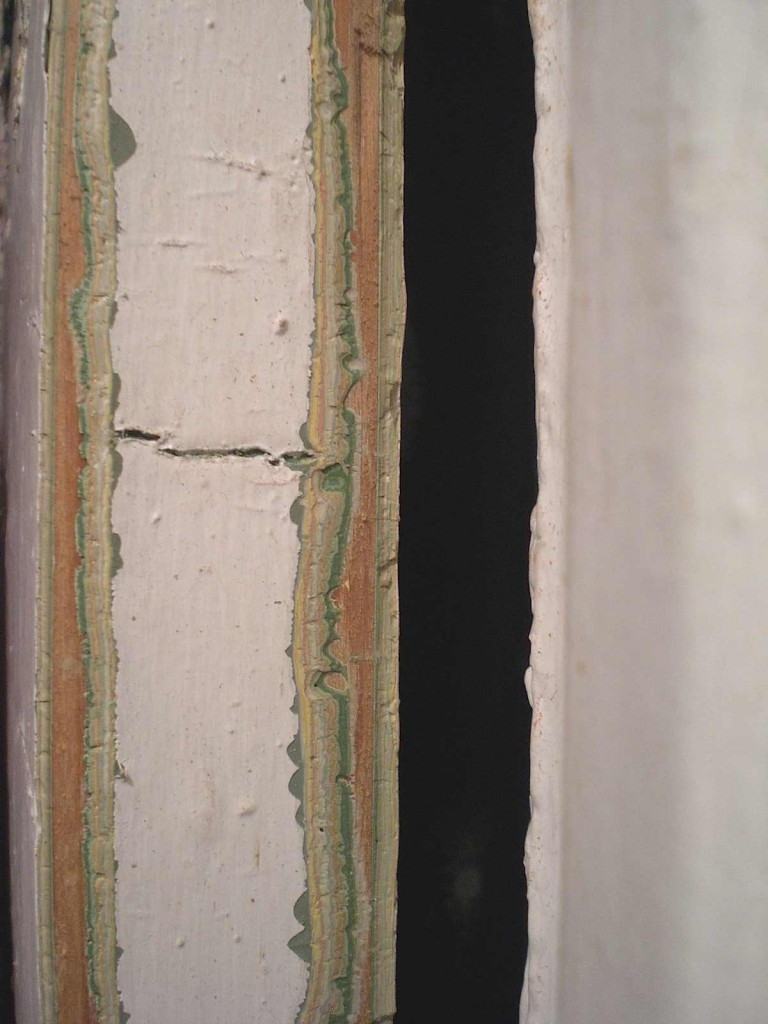
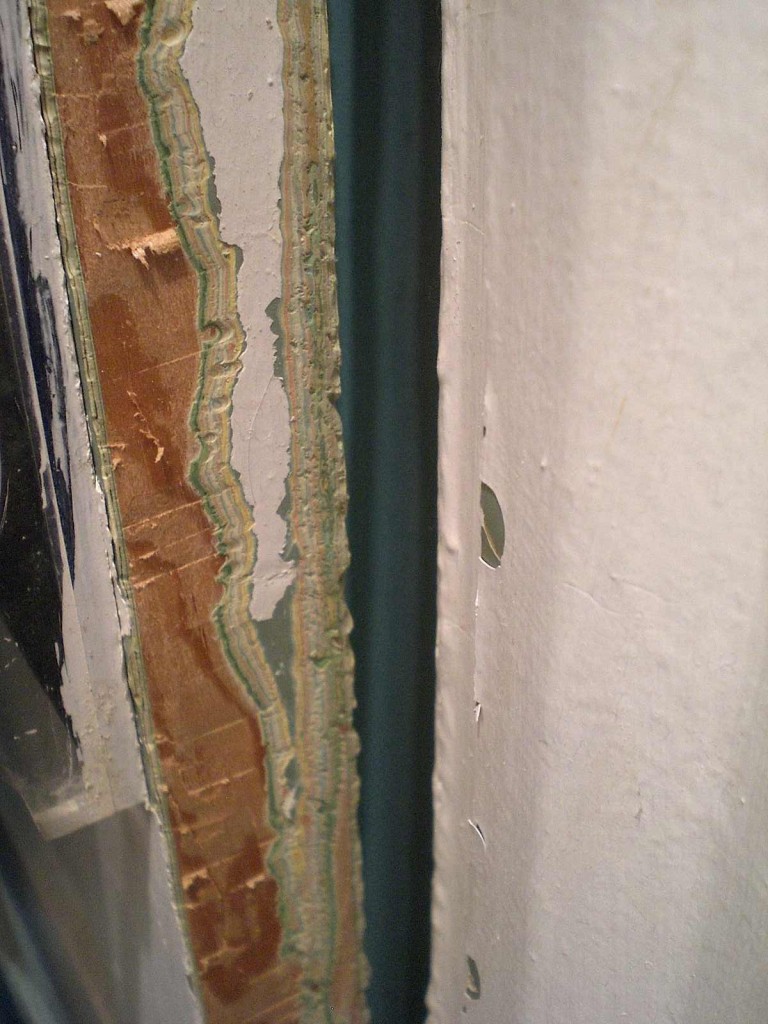
(Um, apparently I took the month of November off?)
- Jack Shafer looks at how Boomers dominate the media, and when this might shift: “By sheer force of numbers, boomers quickly toppled the martini-drinking, WW II generation and substituted their cultural references. In recent years they’ve repelled the next generations—let’s call them the post-boomers for lack of a satisfying rubric that encompasses Gens X, Y, and Z—from taking cultural control.”
- Surely the twenty-somethings behind the new Millenials Magazine will weigh in on this eventually.
- In The Washington Post, Kwame Anthony Appiah predicts what future generations will condemn about our time, and finds three handy signs that suggest a practice is destined for the dustbin of history: “people have already heard the arguments against the practice,” “defenders of the custom tend not to offer moral counterarguments but instead invoke tradition, human nature or necessity,” and “supporters engage in what one might call strategic ignorance, avoiding truths that might force them to face the evils in which they’re complicit.”
- “[W]hy the sudden success of political nostalgia?” asks Matt Bai. Well…
“The most obvious explanation has to do with the economic morass. When a moment is as bad as this one, there is probably a tendency among voters to conflate past moments in the life of the country, on one hand, and the politicians who personified them, on the other. If by comparison the 1980s seemed so much easier and more promising to Iowa voters, then why not just go hire the guy who ran the state then? Surely he’ll know what to do.”
“…We tend to think of generational changes as happening all at once, like a door suddenly blowing open. In reality, though, there are probably hesitations at the threshold, brief moments when much of the country, having glimpsed the future, seems inclined to stay exactly where it has been. And perhaps this is that kind of moment, which is why voters and parties in some cases gravitate toward the last era’s politicians, candidates who seem comfortingly knowable and familiar.”
- The heyday of shmancy travel writing is pretty much over, and Ann Patchett loves to think that it might be her fault.
- Jack Shafer has no sympathy for Ted Koppel. “I know of no more sorry a spectacle than the wizened newsman weeping with nostalgia for the golden age of journalism—which just happens to coincide with his own glory days,” he writes.
- Back in October, the Internet freaked out when the news went around that Sony was ceasing production of the Walkman. It later turned out that they were just discontinuing sales of it Japan, but once the gates of reminiscing are opened, they cannot be closed! The LA Times noted that “the Sony site promoting the device, which sells for $29.99, says the player can be used to ‘enjoy your old cassette collection.’” Awww. (According to the company, there’s still “a consistent but small demand” for the device.)
After a dismissive opening–”Talk about ending with a whimper: Who knew that portable cassette players were still being made at all?“–Slate featured what turned out to be a nice obit that pointed out the ways personal listening devices really changed the way we listen to music, ushering in an age when people walk down the street, “enveloped in the self-selected private soundtrack of his or her life.”
- Elsewhere, camera phones are pissing off musicians and killing live rock shows. “Generation gaps are a given in music culture, but age seems to have little bearing on the urge to gather gigabytes of concert footage,” notes the Wall Street Journal.
- And digital movie projection means no more need for projectionists.
- Pontiac is dead, at age 84. “They had a lot of glory years, but from the ’70s on, Pontiac just couldn’t meet the bar,” said Pontiac fan Larry Kummer. “It was always living in the past.”
- Mark Craig saved all his answering machine messages for two decades and compiled them into a pretty amazing video.
- Lane Smith has a great new picture book that introduces the young’uns to the very concept of a B-O-O-K. But somehow, college kids remember what a book is, enough to still prefer them over digital versions in some cases. The Times learns that while they could get digital versions of textbooks, the kids still “cling” to the kind with pages that can give you paper cuts. Comments from students following the article were mixed, but my favorite is: “Yes i Would. I Love To Listen Rather Than Read. But Most Of The Time If Your Listening To Something You Dont Pay Attention In Class…So Idk It Would Be Good In Some Ways But In Others In Not Sure.”
- In this week where everyone on Facebook is creating “beautiful collages” of their statuses from the past year (not to mention looking back on where they were when John Lennon was killed) I learned that Ninuku Archivist can download all your Facebook updates and put them in a book for you to look through later. These things are both ridiculous, but they do point to a real desire to preserve these ephemeral things we do and say online.
- Writing about Amanda Hesser’s Essential New York Times Cookbook, Jennie Yabroff notes, “Food writing is almost always infused with nostalgia. But when it comes to food trends, we have a recurring case of cultural amnesia.” The book “proves that when it comes to what we eat, there’s no such thing as invention, merely reinterpretation” and that “not only have our tastes changed less than we think they have, but food has always been a key indicator of who we think we are—and who we aspire to be.” And of course, “what’s sexy today may be cringeworthy tomorrow.”
- Men in New York love old school barbershops, and “there’s been a surge of interest in vintage shaving, grooming and barbershop paraphernalia” on eBay. According to one customer, though, it doesn’t make much sense: “They cut great hair at Freemans…But what’s so funny about this illusion of old Main-Street America, where you pop in and get a haircut, is how it just doesn’t jibe with reality. The last time I tried to get one there I was told there was a three-hour-and-20 minute wait. And not only do I think there has not ever been a barbershop on any Main Street that had a three-hour-and-20 minute wait, I don’t know a single New Yorker who can afford to wait that long for a haircut.”
- On the Lower East Side, Max Fish and the Pink Pony are closing. In some ways it’s amazing that they managed to hang on this long.
- “Adult Chocolate Milk”: It exists. Not the most terrible idea, but the story of the company kind of makes my head hurt:
“Just like mom, the original formulas for these drinks were discovered in the home kitchen of Tracy – one of the company’s founders. After updating her Facebook status to “Tracy is enjoying some Adult Chocolate Milk,” friends began inquiring about the recipe and where they could get it.
Among the many thirsty inquirers was NIkki, who reunited with Tracy on Facebook after 18 years. When Nikki tasted Tracy’s recipe, she turned to her and said, “You need to bottle this stuff!” With Nikki’s experience in management and manufacturing and Tracy’s connections, that’s exactly what they did.”

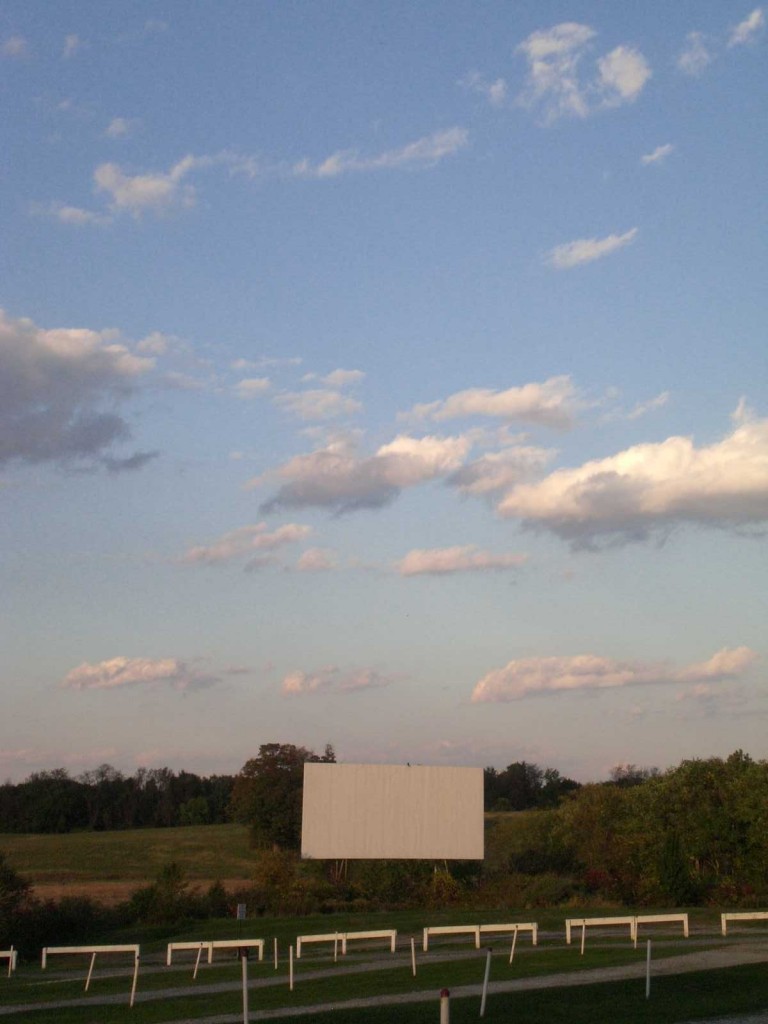
at the drive-in
Fall clichés are my favorite kind. Every year, sometime in October, I have to get out of the city for a couple of days and smell the air and hear the crunch of leaves under my feet and get my first shiver and all of that. Lately, on top of the usual seasonal clichés, there’s the feeling of falling in love with the Hudson Valley—finding more and more things I want to do in the area I grew up in and once thought was indefensibly boring and claustrophobic, and now seems lovely and novel and somehow wide open. I think about telling my 16-year-old self that one day I’d be thrilled to come back, boyfriend in tow, for a weekend of driving around and going for walks and sitting up late with my parents drinking wine…and for all the predictability of this, it gives me a neat little shiver. (For as much as I think about this kind of thing, I also wonder when I’ll finally get over it.)
I’ve been hearing about a lot of people lately (well, “a lot” is relative…) discovering the area and deciding—after having put in their time as broke, sleepless urbanites—that cheap(ish) upstate(ish) real estate and quiet and views of mountains and a (sort of) manageable train ride to the city is exactly what they want, and so they buy cars and move into cute cottages with backyards and gloat about their suddenly simpler and more focused lives. And I get it. I do. Eventually making a similar move doesn’t seem impossible, or at least it doesn’t feel any less impossible than any number of other prospects that are theoretically on the table, places I could maybe kinda sorta think of one day living, places that tempt me on brief vacations or where friends have decamped to and live happily. Because at this point it’s mostly academic, a distanced admiration for little towns with cute coffee shops and inexpensive apartments and that elusive thing we call “character.” It all feels equally abstract, when right now extricating myself from this apartment—where over more than six years I’ve accumulated more books and papers and books and discounted Anthropologie sweaters and books and records and random interesting things that should be hung on walls on which there’s no longer much space—sounds like a nice theory, a plan to enact in some hazy future where I have a salaried job and some kind of clarity, but for now is just fodder for recurring dinner conversations with various friends and relatives following the news of the latest thing that has broken and we don’t know how to fix and which the landlady couldn’t care less about. (Lately, it’s the already wonky bathroom door, which no longer closes at all due to some ancient floorboards that warped irreparably in the summer heat.)
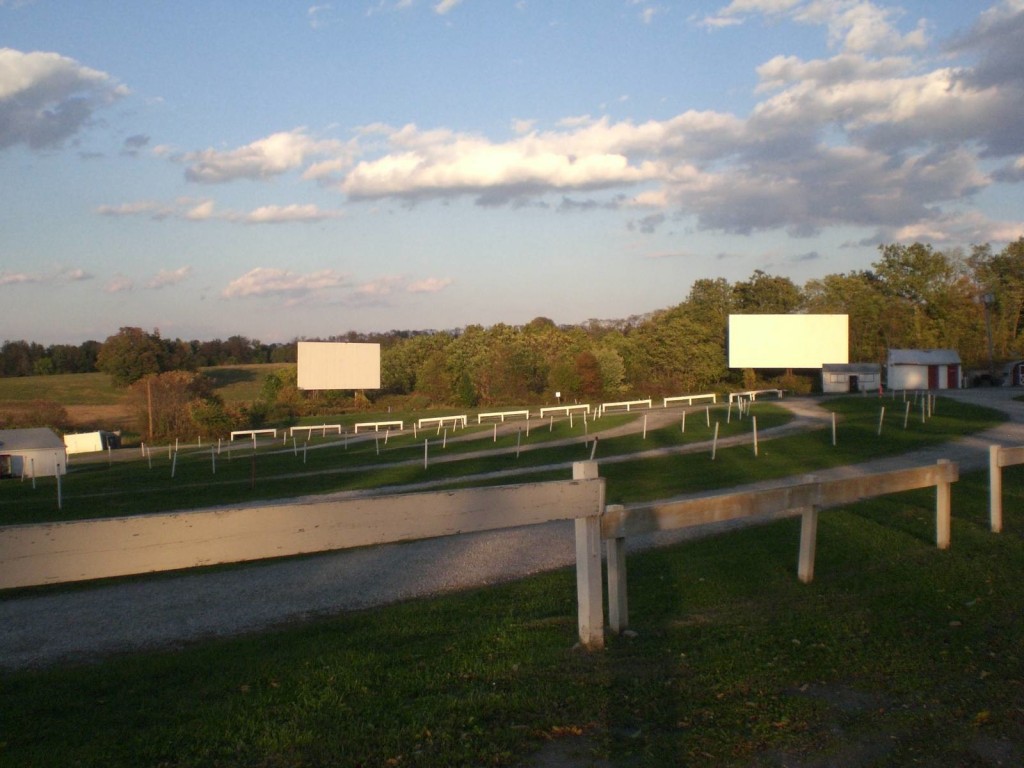
This weekend all I knew was that seeing an empty drive-in theater a little ways up the hill from a strip mall and an apple orchard (yes, both) was an irresistible thing, and that the way the late afternoon light was hitting the blank white screens in front of trees and fields and clouds could have kept me there, taking the same picture over and over again, trying in vain to get it right with the dinky digital camera that’s become a poor if awfully convenient stand-in for the heavy Nikon I used to lug everywhere, until it got dark and people in cars showed up to watch Wall Street 2.

- Surprise: Philip Roth is not a fan of e-books and “the distracting influences of modern technology, which he feels diminishes the ability to appreciate the beauty and aesthetic experience of reading books on paper.” He says, “I like to read in bed at night and I like to read with a book. I can’t stand change anyway.”
- Rob Sheffield, whose first book was about love and tragedy and nostalgia and mix tapes, and whose latest book is called Talking to Girls About Duran Duran, does a playlist for the Times, noting, “Writing about music and writing about memory are basically the same thing.”
- Thank you, James Collins, for pointing out that few people remember everything they read, but that books are worth reading anyway.
- Frank Kovarick definitely remembers The Hardy Boys.
- The Times profiles sidewalk book salesman Charles Mysak, who is depressed about the Barnes & Noble by Lincoln Center closing, and asks, “If a saloon and bookstore can’t make it on the Upper West Side, what better evidence do you need than that of the decline of artistic and free thought? If this is happening here, what must you see in the hinterlands of America?”
- But why stand out on the street if you have a bar-code scanner? Writing at Slate, Michael Savitz is a little embarrassed by his method of buying used books to sell, but it does the job:
The book merchant of the high-cultural imagination is a literate compleat and serves the literate. He doesn’t need a scanner, because he knows more than the scanner knows. I fill a different niche—I deal in collectible or meaningful books only by accident. I’m not deep, but I am broad. My customer is anyone who needs a book that I happen to find and can make money from.
…I rely on a technological castoff to search through other people’s castoff merchandise….My work is crowded by artifacts of thought and expression which the culture hasn’t wanted to conserve.

- I’m about a month behind, but I loved this article about Peter Knego, who collects decor from post-war cruise ships. It’s a little scary to imagine what his house looks like, but this is coming from someone whose floor has warped so much that her bathroom door cannot even begin to close, so. (And actually, maybe my favorite thing is his own website, where there are photos of the old ships he gets this stuff from, being taken apart.)
- A woman left her Paris apartment before WWII and never returned; now her apartment is a time capsule. “[O]ne expert said it was like stumbling into the castle of Sleeping Beauty, where time had stood still since 1900.” It would’ve been amazing even if the place didn’t have a painting in it by the 19th century Italian artist Giovanni Boldini, which just sold for €2.1 million.
- Speaking of which, I love Thomas Beller’s essay about making a home out of your “stuff,” and the eeriness of leaving home for awhile only to come back and find everything where you left it, ready to both reassure and haunt you: “The fact is, I am often transfixed when in the presence of the artifacts of my own existence. Being transfixed is a cousin to being paralyzed.” Various objects and mementos, he finds, “exerted a kind of lunar pull, tugging me out of the present and into the past. It was like seeing an old friend after a long interval and being overcome with the sickening feeling that one of you has changed beyond recognition, that the old magic is gone.”
- With the return of Chock Full o’ Nuts restaurant to NYC (“Get ready for a taste of old New York,” proclaimed The Daily News), Jeremiah’s Vanishing New York put together a “totally unscientific Nostalgia Point system.” Meanwhile, the Algonquin Hotel, which opened in 1902 and where Dorothy Parker used to hang out, is becoming a Marriot.
- Super Mario Bros. turned 25, and everyone has an opinion about whether video games today are better or worse. Other 25th anniversaries: The Breakfast Club. (The cast “reunited” on Good Morning America.) Desperately Seeking Susan. (The Times talks to director Susan Seidelman.) And the premier of The Golden Girls.
- The news that the cast of The Sound of Music is reuniting for the first time since 1965 made me realize I’ve never seen the whole movie. We must have watched it when I was a kid, but I sort of remember falling asleep. The wonderful Rachel Shukert definitely stayed awake to watch Troop Beverly Hills at many slumber parties, but it hasn’t aged quite like she expected.
- Jared Leto’s teen modeling portfolio is amazing. (Calla lilies! Plastic wrap! Long hair! A baby!) And Brian Austin Green explains the world to Details: “90210 only worked because of that time period—because the world didn’t have access to a lifestyle like that. The Internet wasn’t what it is now. With TMZ and Paris Hilton wrecking cars and people being chased on freeways, there’s nothing interesting about Beverly Hills. Beverly Hills is nothing anymore.” And how was it to be famous in the nineties? “Times were simple then.”
- I haven’t read Sara Marcus’s riot grrrl book yet, but Jessica Hopper calls it “a study in memories colliding“:
There is a part where a girl who I don’t remember at all describes me as quiet, insecure and intimidated. I think she has me confused with someone else–she must, I have never been quiet in my life and didn’t know intimidation until I knew humility, which wasn’t until, like, maybe 2004.
- And here’s Hopper interviewing Superchunk’s Mac McCaughan for the Chicago Reader:
JH: On the new record, there’s this nostalgic feeling, but also a sense that you’re policing yourself—that you’re really aware of not wanting to be too wrapped up in the past.
MM: That’s the dueling feeling. It’s something that’s powerful—it’s also about music’s role in nostalgia and its ability to trigger it. It’s a powerful emotional thing, whether it’s about music starting to mean something to you in a real way or a time when music was life changing. It’s different the first time you see Bad Brains. . . . When you’re young, so many things are happening, related to music and not, and that’s all really exciting.
Later, he tells her, “What you’re looking for in nostalgia is that energy.”
- At The Millions, Jacob Lambert takes stock of his favorite “vanished” t-shirts: “In exchange for their service—absorbing our sweat, airing our interests, starting our conversations—the least we can do is offer them tribute.”
- Scientific American sort of explains déjà vu:
All theories of memory acknowledge that remembering requires two cooperating processes: familiarity and recollection. Familiarity occurs quickly, before the brain can recall the source of the feeling. Conscious recollection depends on the hippocampus and prefrontal cortex, whereas familiarity depends on regions of the medial temporal cortex.
Basically, déjà vu is what happens when those things get out of snyc. Okay.
- David Carr looks at how generation affects your interpretation of The Social Network:
“When you talk to people afterward, it was as if they were seeing two different films,” said Scott Rudin, one of the producers. “The older audiences see Zuckerberg as a tragic figure who comes out of the film with less of himself than when he went in, while young people see him as completely enhanced, a rock star, who did what he needed to do to protect the thing that he had created.”
My parents, who are not on Facebook and don’t really understand it, loved the movie. My brother, who hates Facebook, is dismissing it because he can. And I loved it because Trent Reznor’s score was great.
- At The Awl, it’s enough already. “This epidemic of easy-to-manipulate “arty” images infesting our blogs and our Facebook pages is way out of control”:
But we have learned to “think” in images this way. These are romantic and really somewhat infantile image techniques. They’re childish and nostalgic. They’re about sunny days and buzzing bees and reading books on a porch, and about road trips and romanticizing urban grime and being oh so gently alienated.
And really, it’s gross.
- A few other things that someone noticed recently ain’t what they used to be: Travel writing. (“The ease of the transitory has hidden the necessity of the eternal.”) The “decadent novel.” (“[T]hose bejewelled, subversive, gloriously unhealthy texts.”)

 The little boy in this photo might be my brother, or it might just be some random kid. (I found it in a pile my parents were throwing out, in an attempt to get rid of some extraneous stuff.) Which is more interesting?