

Jezebel flips through Time Out New York’s sex issue from 1996—a year “when business was booming and ‘hookup culture’ hadn’t been invented yet”—and finds that things were sorta-kinda different then, but not really.
Meanwhile, The Awl takes a pretty ambivalent look back at Kids, on the fifteenth anniversary of that movie’s release.
The Times reports on an annual reunion of people who posed for Norman Rockwell—those still around are mostly elderly folks who modeled for Rockwell as kids. I do wonder what they have to talk about…how much mileage can they really have gotten out of that experience? The paper also recently offered a dispatch from the Chinatown Fair video arcade—”one of the last of the traditional arcades left in the city”—and a piece pointing out how, despite it being difficult and sort of useless, psychological researchers are determined to find a basis for generalizing about generations:
Generation Y’s collective personality, if such a thing exists, is not likely to be much different from other generations’. Still, small differences may matter…[one psychologist] has found a slight decrease in trust over the generations and a slight increase in a something called “ascendancy,” or “competence” — a self-professed confidence in getting things done.
At Jeremiah’s Vanishing New York, an elegy for the “cluttered little beauty” of a Union Square newsstand that was recently replaced by one of the slick new glass and steel designs.
e.p.t. brand pregnancy tests are offering a special pouch you can send in for, in which to preserve your peed-on pregnancy test and by extension, “the moment you knew.”
Anticipating a time when “[b]ooks will…suffer the fate that has already befallen letters sent by mail: preciousness,” Mark Oppenheimer writes in Slate about what we lose when electronic devices take the place of books, whose covers we’ve come to count on to tell us something about the person reading them: “[W]hat will you do, Kindle generation, when you cannot tell which of the quiet boys holding the e-reader on the subway is engrossed by the latest, predictable legal thriller, and which one by a cheery, long-forgotten Laurie Colwin novel?”
At Salon, Matt Zoller Seitz commemorates Kodachrome film, the very last frames of which were produced last month:
Kodachrome photos were luminous and warm but not garish; in some inexpressible way, they seemed to capture the sensation of remembering the past, fixing nostalgia along with people and places….Its official end as a commercial format — one that you could just drop off and pick up at the local pharmacy — is yet another notable marker in an ongoing story: society’s total conversion from analog to digital media….That’s ultimately what the end of Kodachrome is really about: the end of a small but significant kind of poetry that was bound up with analog image-making.
Right, Katie Roiphe’s piece about Mad Men from a couple weeks back: “In the early ’60s they smoldered against the repression of the ’50s; and it may be that we smolder a little against the wilier and subtler repression of our own undoubtedly healthier, more upstanding times,” she writes by way of explaining our obsession with the show, and suggesting that we might learn to embrace some of the oh-so-sexy “messiness” that shapes the lives of its characters. “Juxtaposed against all this flamboyance, the tameness of contemporary sins can be a little disheartening.” Maybe it’s the attempt at juxtaposition that’s the problem?
In a smart response at The Awl, Peter Birkenhead wonders, “Where has she gotten the positively Mad Men-era idea that ‘embracing the responsibility’ of marriage precludes a messy, exciting—sometimes even transcendentally so—life? Does Roiphe not get that, in her creaky old (and exceedingly bougie) critique of ‘bourgeois culture,’ she sounds like one of the be-goateed trust-funders Don meets during the first season of the show?”
Speaking of Mad Men (and really, when aren’t we?), Ruth La Ferla considers the relentless cycle of nostalgic fashion, most recently inspired by the ubiquitous show: “Lately though, such revivals seem shopworn — not to say mindlessly literal. Where, after all, is the irony in pushing replicas of grandma’s twin sets, camel’s hair coats and crinolines on a generation bred on loose-fitting T-shirts, denim and cyberworld tints?”
And check out these gorgeous color photos taken between 1939 and 1943…It’s amazing how your whole sense of that time can change when you see it captured in something other than black-and-white. Call it The Wizard of Oz effect?
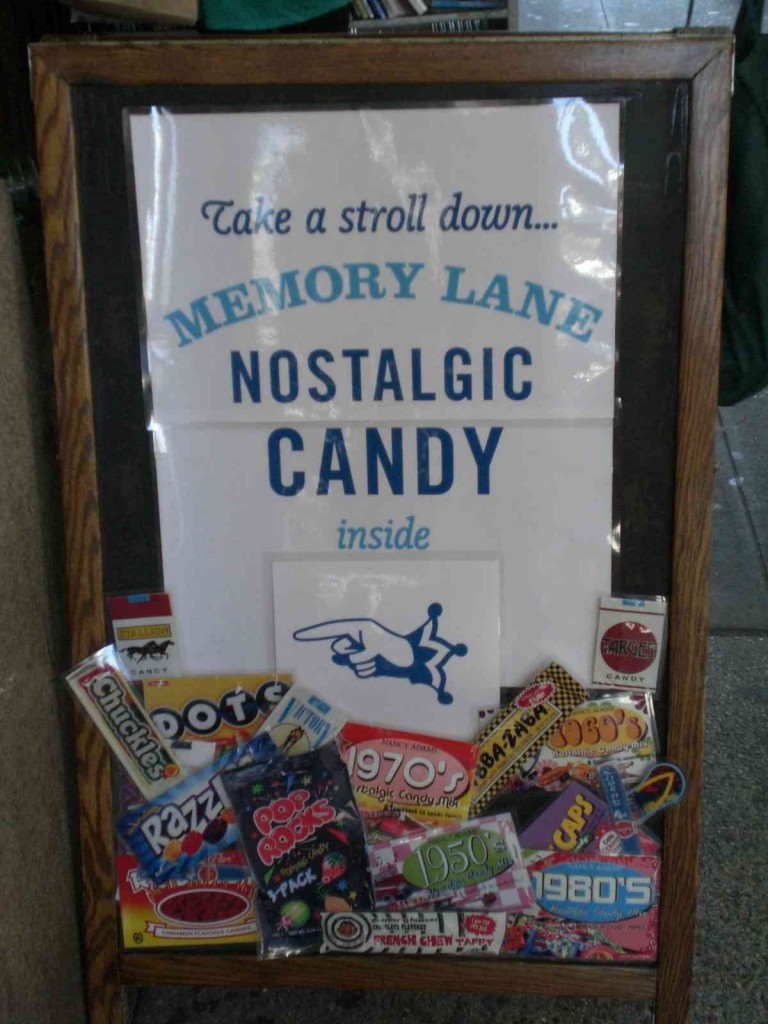
If you look closely, you’ll see that there are “nostalgic candy mixes” for each decade. Amazon, which also sells them, describes the 1950’s mix thusly:
This swell medley of sweets is guaranteed to bring you back to an unforgettable decade where Moms stayed home, girls wore poodle skirts and the boys revved the engines of their Chevys and T-birds. The milkman delivered the milk in glass bottles right to your door, and all your favorite music was played on 78’s and 45’s. Saturday morning cartoons were incentive enough not sleep in, even in black and white. You might’ve done the Bunny Hop, worn saddle shoes or spilled Kool-Aid on your dungarees. But it was all done in the 50’s and you wouldn’t change it if you could.
Yum.

Can’t see what that says? Let’s zoom in:
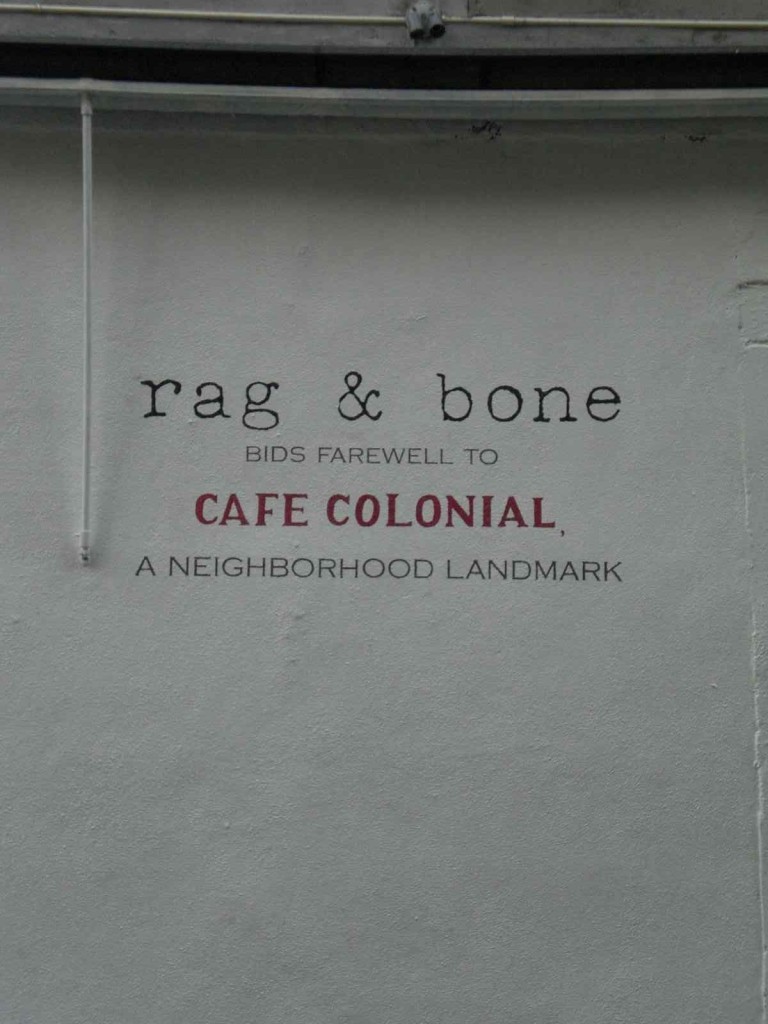
So, a high-end clothing retailer moves into the space a neighborhood Brazilian joint occupied for fifteen years—which it had to leave because of an unaffordable rent increase—and decides to pay tribute to its beloved predecessor. I’m pretty sure this is what guilt-ridden gentrification looks like. I guess it’s better than the other kind…?

Before we left for Maine I was looking at a bunch of local tourism and Chamber of Commerce sites, trying to find places to stay and just generally looking at what would be going on while we were there. Aside from sections about accommodations and restaurants and weddings, there was almost always one called something like “Relocate.” Camden’s site featured this little blurb:
Remember the days when neighbors were friends, and your friends ran the local shops and banks? Remember a place where traffic came to a halt for the Soap Box Derby rather than the rush-hour derby? Here where the mountains meet the sea, it’s even better than you remember.
I don’t remember those specific days, to the extent that they ever existed—but I think often about other, more recent ones, and I guess I have equally romantic notions about them. When John and I were walking around that town one afternoon, after salivating over old books and prints and photos and magazines in my favorite kind of rare book shop (where I couldn’t stop myself from buying one amazing issue each of Ladies Home Journal and Better Homes and Gardens from 1954), I was thinking how it’s sort of strange that we ended up on vacation here, and that we even love this place at all. Lots of these coastal towns feel like places for families with young kids, beacons for middle-aged and retired couples (and the occasional young one decked out in pastels) who just want to put their feet up and eat chowder. They’re idyllic in the most obvious and self-conscious ways, even if those ways are genuine ones. The cuteness and kitsch makes me smile, but neither of us would ever think to come here if we didn’t each have a connection with Maine as an idea, a place full of memories that have very little to do with logo sweatshirts, lighthouses, or lobster.
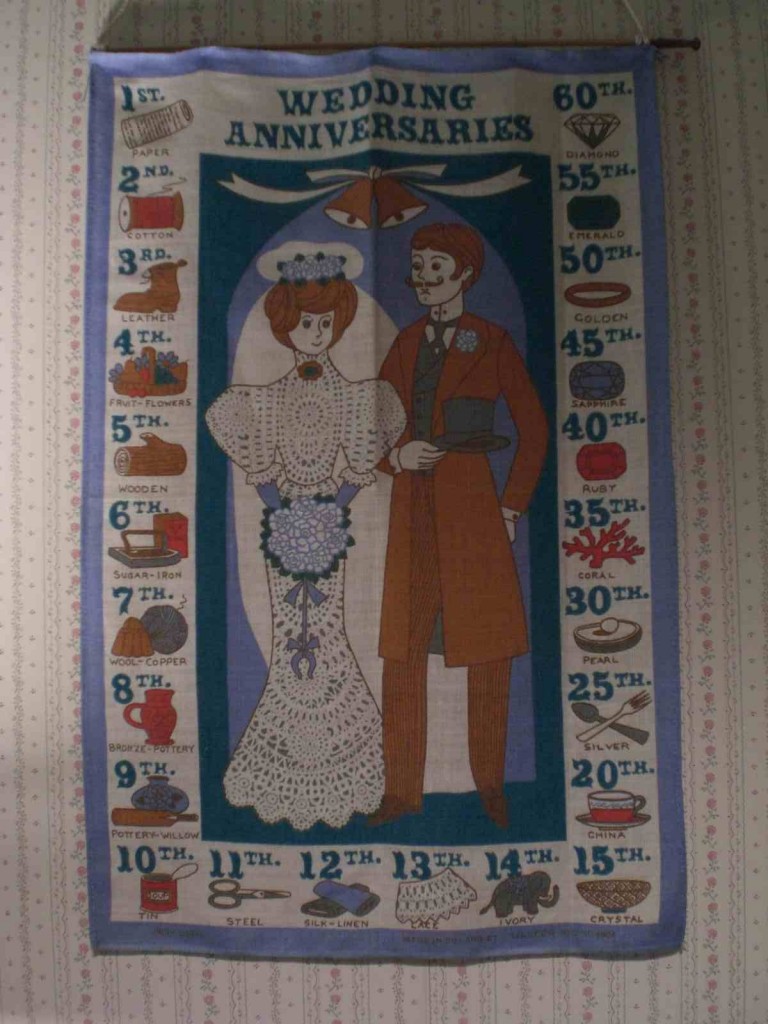
This tea towel was hanging on the wall of our room at a B&B in Belfast (tea towels as wall decorations, enough said). I couldn’t stop staring at it. The first fifteen years of wedding anniversaries are all spelled out with their own symbols, and then there are five year leaps between significant numbers. Who decided on these things, and what was the logic? Why does silk and linen come after steel? Coral after pearl? Wood after leather? Why lump together wool and copper, sugar and iron, pottery and willow, and pottery and bronze? How did they get from lace to ivory in only one move? What is it supposed to mean? There’s probably a charmingly old-fashioned explanation, but hanging at the foot of the bed it felt like a puzzle, and maybe also a taunt.
In Rockport I was fighting the feeling that I needed to make some kind of pilgrimage to the house I lived in for two months, nine summers ago. It seemed possible that I wouldn’t be back to the area any time soon, and it felt sort of necessary to visit that place, the way I did three years ago—just to drive by and notice it, I guess so I’d be able to tell myself I’d been back. I don’t really know why I always think this kind of thing will be reassuring, or even illuminating. Ultimately I decided that driving through town was enough, and that I needed to be okay with not paying a specific visit—that there was nothing there to witness or memorialize that I hadn’t already. That felt like some kind of progress.

The first night back from vacation, I slept the weird kind of sleep I sometimes do, where I’m not fully dreaming, but have a very clear sense that I’m somewhere else. I woke up many times that night, back in the cramped East Village loft bed with insistent cats, but it was to a feeling of being content and cozy, curled up in a nook in a little cabin somewhere on the coast of Maine—a calm that seemed to come from nowhere, but can probably be traced back to a residual sense that I was still close to water and craggy rocks. This despite coming to terms—while in both Portland and sleepy little coastal towns—with the fact that as much as I love Maine in all of its Maine-y-ness, it’s hard to imagine actually following through on my hypothetical lust for living there, and that I’m sort of okay with that. Maybe my displaced dream state had something to do with having just torn through Meghan Daum’s amazing memoir of love and real estate, Life Would Be Perfect if I Lived in That House, which was making me think about living spaces—urban, rural, real, imagined, idealized, falling apart—even more than usual.
Getting back to the city, as usual after returning from some time away, felt disconcertingly simple, things unchanged in a way that’s both reassuring and infuriating. The second night back we were woken up at 6am by a group of people who’d decided it was a good time to drink beer and smoke and laugh on the small patch of roof at the bottom of the air shaft right next to the bed, two short floors down. Their voices and bottle-clinking were amplified by what’s essentially an echo chamber, the disorienting sounds rising up right next to us in a way that felt unnervingly intimate, a low buzz of voices sneaking in through the cracked and therefore permanently curtained window, along with the stink of early morning smoke. That it was a Tuesday did not bode well.
Last night—night #3—was better, which maybe means I’m actually home.
So cool: Part of an 18th-century ship (“30-foot length of a wood-hulled vessel“) was found at the World Trade Center site, 20 to 30 feet below street level. “The vessel, presumably dating from the mid- to late 1700s, was evidently undisturbed more than 200 years.”
David W. Dunlap’s lede is totally over the top, but also sort of adorable: “In the middle of tomorrow, a great ribbed ghost has emerged from a distant yesterday.”
I know Flavorwire means well with this list of ten women writers they love—supposedly, it was inspired by the whole Jezebel/Daily Show fracas, and I guess any large-scale conversation About Women gets people thinking about where women are and are not in every area of art and life. But the fact remains that this is a list of mostly excellent writers (Kendra Wilkinson’s on it, wink-wink) that lumps together short story authors, novelists, journalists, essayists, a beloved 94-year-old YA author, a vacuous reality star, a young debut novelist and established authors with several books to their name–all on the basis on their gender. That the list isn’t meant to be definitive or prove anything (unlike several of the more controversial lists of late that have “coincidentally” excluded women, or the the lists made specifically to rebut them which tend to limit themselves to specific publications years or genres) actually makes it more baseless. Really, what is the point here?
Meanwhile at Salon, Laura Miller has an awesome takedown of critics like Lee Siegel and Malcolm Jones, who turn up their noses at Shirley Jackson (the hook being her recently issued Library of America collection of novels and stories, with an introduction by Joyce Carol Oates) while mythologizing the supposed heyday of fiction by “Bellow, Updike, Mailer, Roth, Cheever, Malamud” (that was Siegel specifically, arguing in the wake of The New Yorker’s “20 Under 40″ that “[f]iction has become culturally irrelevant”). Miller offers a pointed, badly needed corrective to their lazy view of the past:
Mid-20th-century Americans believed that novels by the jostling alpha males on Siegel’s list were important and “central to their lives” largely because a chorus of cultural authority figures united to tell them so. That’s not to say that those novelists weren’t fine writers, or that the depiction of an upwardly striving middle-class descended from relatively recent immigrants (many of them Jewish) didn’t provide lively new subject matter. But it certainly wasn’t everyone’s story (as it was often made out to be), or a literature that everyone found interesting or that everyone would have consumed with “existential urgency and intensity” in absence of those endorsements.
She also handily debunks the idea that there’s any such thing as objective “greatness.” The piece goes a long ways towards relieving the perma-headache I’ve developed from reading so much redundant interweb squabbling about all sorts of literary lists (the New Yorker one just the most recent among them), along with the aforementioned Jezebel/Daily Show thing. Clearly the lesson is that I should turn off the computer and go read some Shirley Jackson.
I love Ellen Lupton’s piece on the Times website today about heirlooms and legacies. (Ever wondered what an heirloom chicken wing might look like? Go find out.)
Also in the realm of fading/obsolete/nostalgic, the Times recently took a look at cigarette machines, along with the dwindling number of small old movie houses that are apparently “little changed from the days when itinerant projectionists packed their automobile trunks with reels of film and hit the road,” and are often volunteer-staffed by Boomers, “the last picture show generation on the plains.”
On the occasion of a new exhibit of Norman Rockwell’s work (weirdly, from the collections of George Lucas and Steven Spielberg), Deborah Solomon finds that Rockwell’s “cheerful America has lately acquired a startling relevance both inside and outside the art world, in part because it symbolizes an era when connectivity did not require a USB cable.” Ah yes, also “a world where Americans convene in old-fashioned drugstores and barbershops, conducting themselves with a sense of integrity and fair play, with gumption and whimsy.” Those were the days! Rockwell illustrated “America before the fall, or at least before searing divisions in our government and general population shattered any semblance of national solidarity.”
Similarly interested in myth-making (though with even less of a grasp on reality) is Fortune editor at large Patricia Sellers, who is just shocked to discover that members of generation Y don’t care about having careers, prioritizing “fun, innovation, social responsibility, and time off” instead of Boomer values like “pay, benefits, stability and prestige.” The commenters pretty much handed her patronizing ass back to her, as did Maria Bustillos at The Awl.
After going to see Tuscadero, a band she last saw when she well before she could drink, Emily Gould offers her “very brief and Internet-friendly explanation for the ongoing explosion of 90s nostalgia, and why people have such complicated responses to blog posts that seem, at first glance, to say nothing more than ‘remember when?’”:
It’s hard to tell whether we feel more or less old than people in their late 20s have felt in previous eras. We keep hearing that we’ve lived through the profoundest cultural paradigm shift w/r/t how information and art are disseminated since the invention of the printing press, but also a lot of stuff is the same as it was when we were teenagers…. It’s hard not to be nostalgic for the world as it was 15 years ago, especially because at first glance today’s world seems so similar, and because it is so different. Underneath, everything is different. The biggest difference is that the sources of underlying difference — everything underlying everything, really, information itself — seems more available now. All veneers seem easily peel-back-able in a way they didn’t, in 1995. Are they, really, though? Or are we just more willing to accept the first result, the easiest answer?
In his smart, lovely piece about searching for the real diner depicted in Edward Hopper’s famous “Nighthawks” painting, Jeremiah Moss (of Vanishing New York) concludes:
Over the past years, I’ve watched bakeries, luncheonettes, cobbler shops and much more come tumbling down at an alarming rate, making space for condos and office towers. Now the discovery that the “Nighthawks” diner never existed, except as a collage inside Hopper’s imagination, feels like yet another terrible demolition, though no bricks have fallen.
It seems the longer you live in New York, the more you love a city that has vanished. For those of us well versed in the art of loving what is lost, it’s an easy leap to missing something that was never really there.
Flavorwire looks at hipster America’s ten favorite movies (or some of them, anyway), many of them nostalgia-reliant, and suggests we get over them–not the worst linkbait I’ve ever seen, but still annoying.
In related news, A.O. Scott recently revisited a beloved movie that didn’t make that list, but easily could have: Dazed and Confused. “The film doesn’t have overt historical references,” he says in the Critics’ Pick video, “which just makes it feel that much more real.”
And at Slate, Dana Stevens finds herself a fan of the Grease sing-along. “In a summer of sequels and remakes and all manner of pop-culture pillage, you have to give Paramount respect: Rather than trying to ‘reboot’ Grease for the new millennium, the company has simply dusted off the top-grossing musical of all time, slapped some words under the songs, and sent it back out on the market to reap whatever profit it can.” She also notes that “Thirty-two years after its original release, Grease has multiple layers of nostalgia to strip away in order to win over a generation that (like every new generation) is mercilessly un-nostalgic,” especially considering that this is “a musical about the mythical 1950s as filtered through the idealizing lens of the 1970s.”
Meanwhile, the Vintage Ads blog is asking readers to choose which of five old ads is the most sexist. It’s a tough decision.