Uncategorized
In a sign that they are perhaps the least self-aware retailer ever, the facade of a new Urban Outfitters store being planned for the Upper West Side will be designed to look like four different storefronts: “a hat store, a hardware store, a neighborhood bar and a bodega.” I’ll just let the designer explain the brilliant, sensitive rationale:
“The whole idea was to do this kind of ironic statement of lining the building with storefronts that would be reminiscent of independent businesses,” says Ron Pompei, creative director of Pompei A.D., which designed the store, slated to open in August. “It’s the story about the streets of New York as they once were.”
In writing this piece for TFT about first kisses (and the zine of same name), I came across this cute and instructive eHow article, “How to Have a First Kiss.”
A week or so ago, Thursday Styles filled us in on the “end of the best friend“–apparently kids these days mostly hang out in big groups. Ah, yes: “The days when children roamed the neighborhood and played with whomever they wanted to until the streetlights came on disappeared long ago, replaced by the scheduled play date. While in the past a social slight in backyard games rarely came to teachers’ attention the next day, today an upsetting text message from one middle school student to another is often forwarded to school administrators, who frequently feel compelled to intervene in the relationship.” I’m skeptical.
This article about an 89-year-old woman who fought the police during the Stonewall riots in 1969 and now sits in a nursing home trying (and mostly failing) to remember it all, is beautiful and heartbreaking.
Here’s a compilation of Publishers Weekly’s annual bestseller lists since 1910. Meanwhile, The Awl looks at complaints about The New York Times in 1910 and 1911, and finds not much has changed.
I’m sort of fascinated by this article in Harvard Magazine that follows up with some people who dropped out of the ivy league in the sixties, both to see how their lives turned out after (gasp!) abandoning a Harvard degree, and to ask how they think back on that time today.
For Father’s Day, the BBC points out that that dads in earlier times weren’t always “tyrannical patriarchs whose children were seen and not heard and lived in fear of father’s punishments.” If we imagine that benevolent–even loving!–fathers are a recent invention, “Nothing could be further from the truth.”
I’ve never seen Leave it to Beaver, now available in an exhaustive box set. “Think of it as a 234-episode history lesson, of a family, a country, a medium,” explains Neil Genzlinger in the Times. “Each installment has a few pearls worthy of that necklace June is always wearing (even while doing housework).” Bonus: According to Ken Osmond, who played Eddie Haskell, “Kids are still the same as they were in 1810.” The very same day, the Times ran an article about the 30th anniversary of Airplane!
“50 years after [Playboy Clubs] were invented and 22 years after they closed,” NPR’s Scott Simon talks to some former Playboy Bunnies.
In Foreign Policy, Christian Caryl hazards a guess as to why the 1970’s “are still haunting us today.”
Finally, there will be a movie based on those troll dolls that haven’t been much of a thing in years.
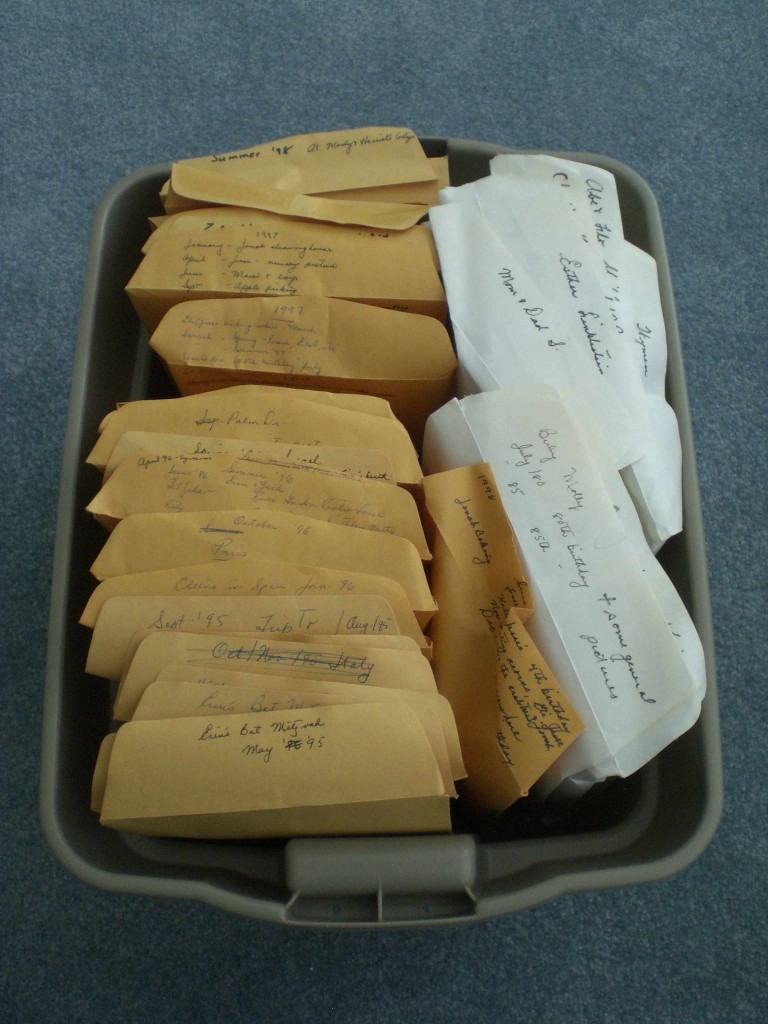
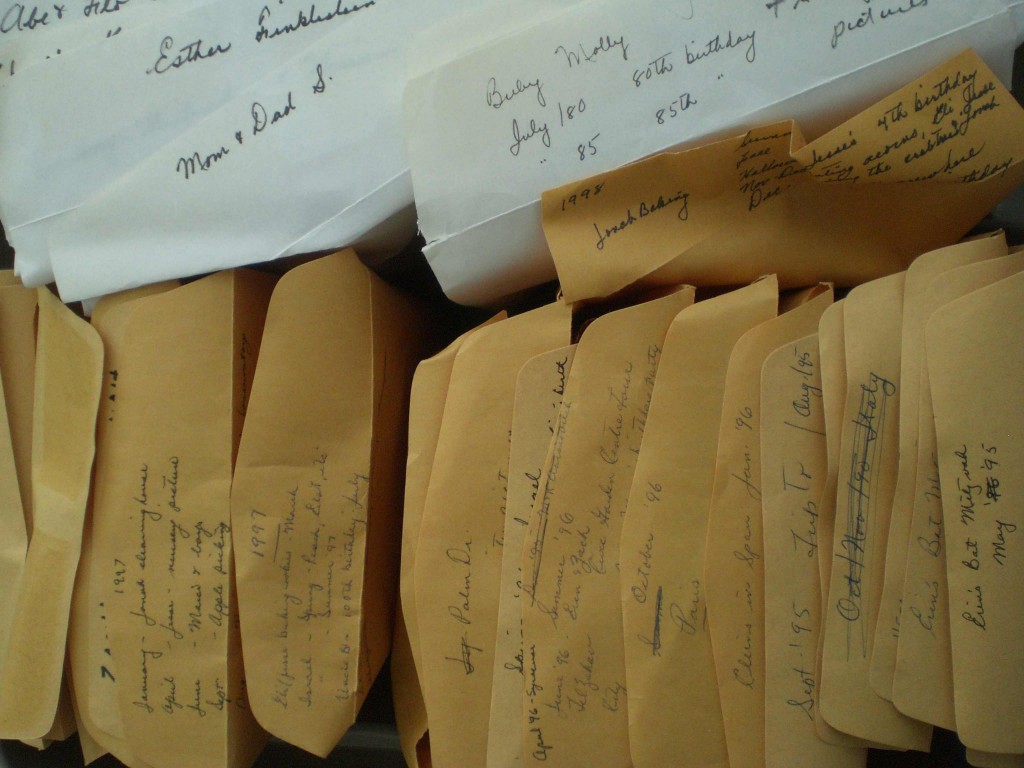
My grandmother’s recipes, meticulously filed and organized. I wanted to take better, more careful pictures of them, but I didn’t have my good camera with me and there wasn’t really time anyway, so they went on the carpet by the door to the balcony, and I did what I could.
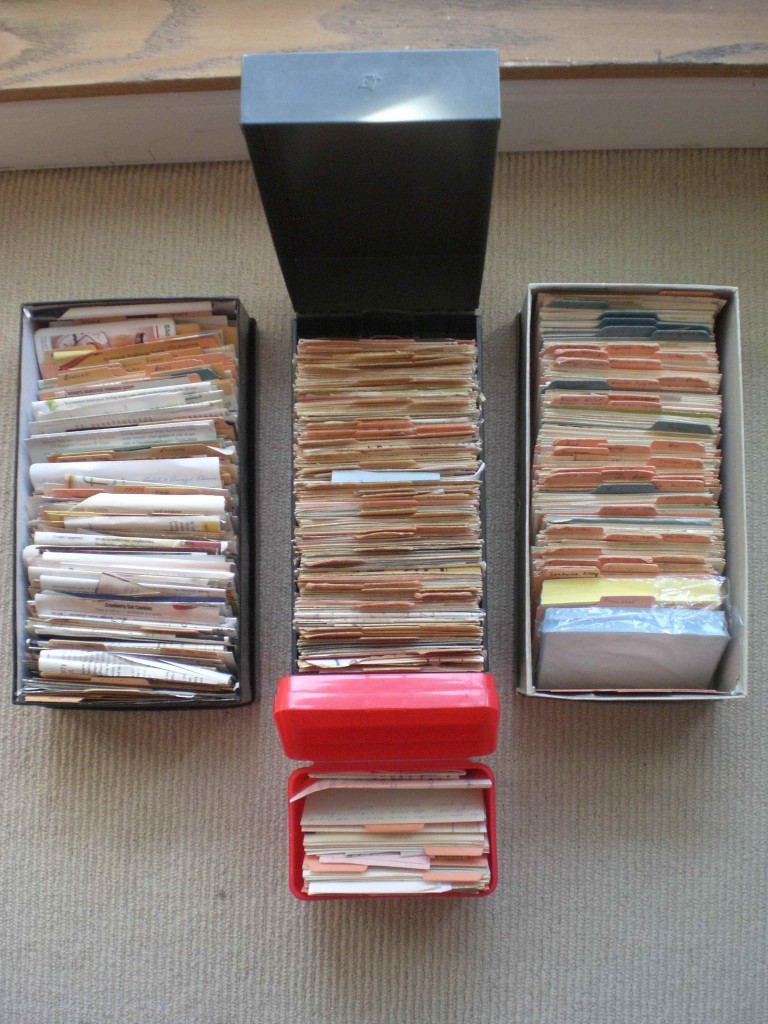
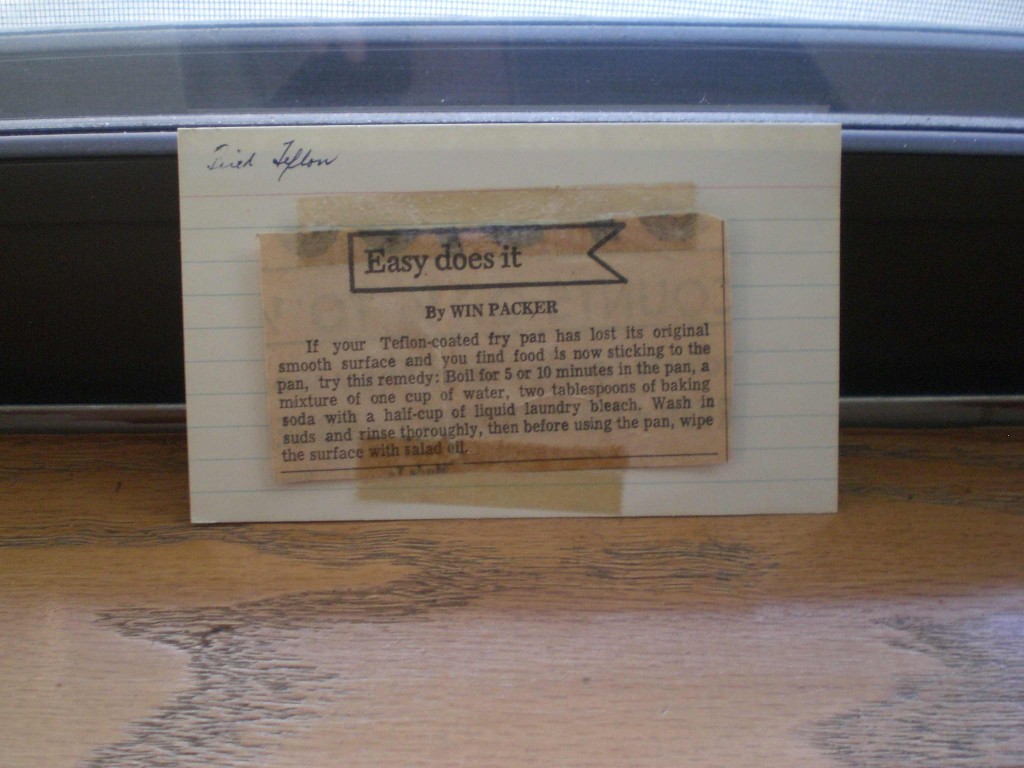
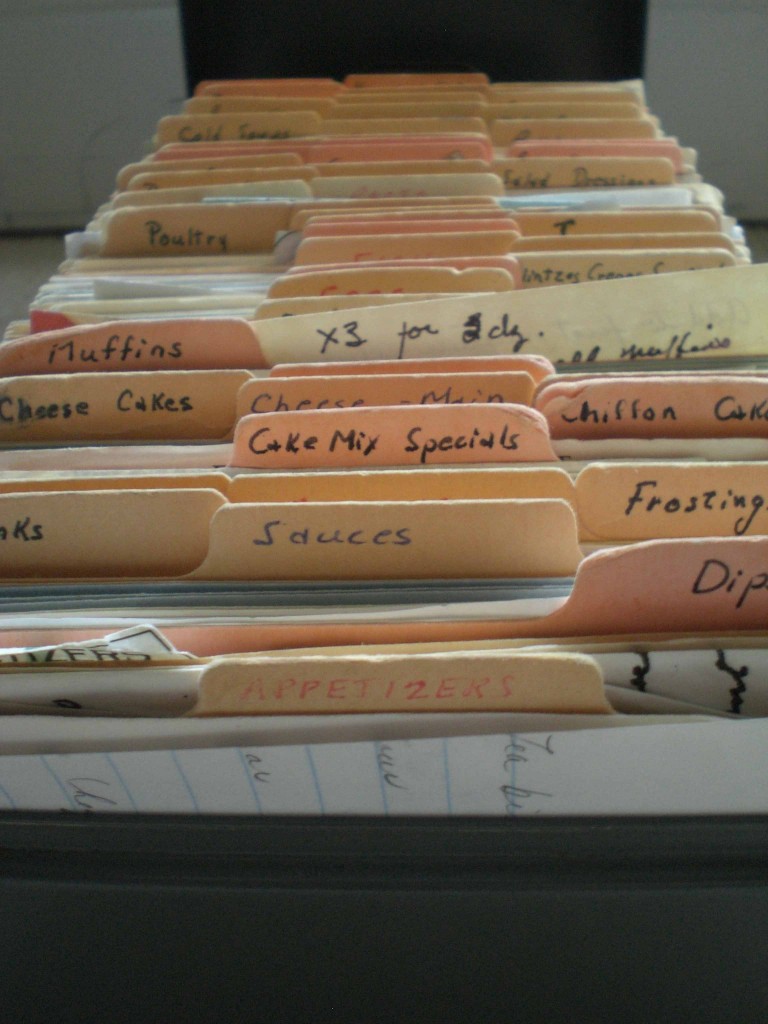
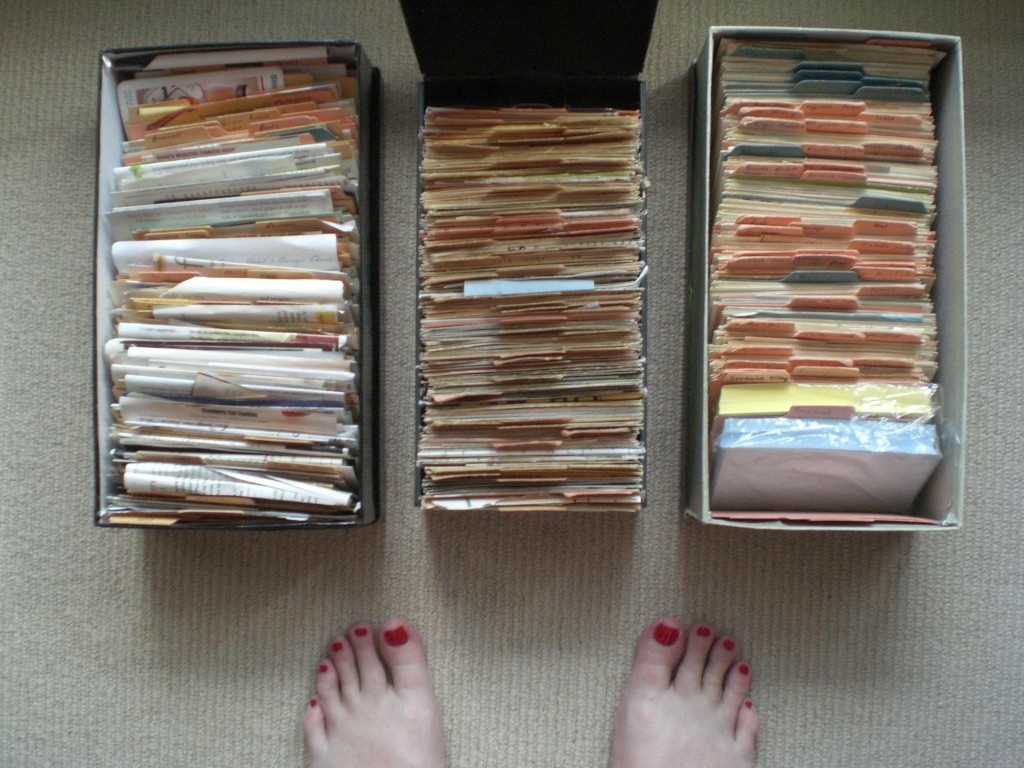
In Obit, Matt Katz rues the death of idle time, and Matt Flegenheimer reports on the closing of NYC restaurant Gino’s, a place that stayed “frozen in the ’40s”:
Gino’s eldest loyalists have lived through crippling wars, sea-changing revolutions, 12 presidential administrations — every verse of “We Didn’t Start the Fire” by Billy Joel, whom they’ve never heard of. At Gino’s, the most noticeable timestamps were the modest price hikes, marked by thick scribbles atop the old rates on Circiello’s original, handwritten menus.
“What we’re losing is a touch of that time,” longtime regular Gay Talese said from beneath his gray fedora on the last night.
Meanwhile, the blog Lost City–”A running Jeremiad on the vestiges of Old New York as they are steamrolled under or threatened by the currently ruthless real estate market and the City Fathers’ disregard for Gotham’s historical and cultural fabric”–has called it a day, with a depressingly honest post titled (what else?) “Goodbye To All That.” “I’m tired and discouraged, and I don’t relish hanging around just to record the last few living landmarks as they fall in this barren forest, making no sound that the City Fathers can hear,” wrote blogger Brooks of Sheffield. “Nor do I much enjoy scouring the street looking for vestiges of the city I loved, vestiges that are harder and harder to find.” Still, “As a writer, [Lost New York is] the purest and most idealistic thing I’ve ever done.”
Well! How about some old photos of Coney Island sunbathers, by Magnum photographer Bruce Gilden?
On Saturday night we went to the Upper East Side and drank cheap beer in the sprawling, river-view apartment of some very rich people that a friend-of-a-friend works for. The family was away at their weekend home, as they apparently are most weekends, and being generous folks, they let this acquaintance of ours hang out and have friends over when they aren’t around. Being there was great, but also felt like the set-up for a joke or a short story, or maybe the basis for an experiment.
From the start, there was a tinge of Big to the whole thing: choreographed fights with the kids’ glowing life-size lightsabers (the Star Wars fantasy probably more exciting for us than for anyone under the age of fifteen), a Wii system along with what looked like every available game. I sat in the mammoth kitchen watching across a long, darkened dining/sitting room area (complete with fireplace) that was bigger than our whole railroad apartment, as people hit invisible tennis balls at a screen in the wood-paneled “library.” Part of the place was a “hall of closets” (there were, I think, six; all of them large or walk-in). John fixated on the amazing stereo system, controlled by a palm-size touch-screen remote that seemed to be able to access every song ever recorded. I made a joke about how the people who lived there must not really be rich, because they only had one giant oven; everyone laughed and told me to look around the corner in the kitchen, where there were two more. I peed in each of the four bathrooms, all of which had sculptural sinks and big showers surfaced in intricate tilework; the walls of one of them was made of oversize limestone bricks that looked like they belonged in the Egyptian wing of the Met. We could all be in separate rooms and hardly know that anyone else was there.
There are all these doors in New York, all these buildings you look up at and wonder about, worlds you’re shut out of until a random connection opens one up for you and offers up the life inside like proof of something you knew all along but didn’t quite have a reason to believe. I knew in a general way that lives like this were happening, but now there was a $300 tag on a basic tank top hanging in a faceless wealthy woman’s closet, a shopping bag from Barney’s with a sticker on it that indicates it came by messenger, because when you are this rich you don’t need to summon the energy to bring your shopping bags with you wherever you are going; everyone is more than happy to come to you. This is normal to these people: beds made up to look like monuments, marble surfaces and window seats and a service entrance, towels that are startlingly soft. Cliché as it is, it’s hard not to think that if you lived here you would be transformed. For your clothes to live in these closets, you would have to be someone else. For some reason I really wanted reasassurance that the owners were nice, that they loved each other.
I don’t like to think of myself as someone made uncomfortable by wealth, but it was hard to have a conversation that night without being distracted by what was around us. The distance between here and there is hard to process, even if my awe of the place didn’t necessarily have much to do with my desire for it. When we were ready to leave we hit the button for the elevator, and it arrived with the doorman inside, as I guess it always does, an escort between the swanky lobby and a floor only one family lives on. It was late and we were far from the subway so we took a cab home, and when we unlocked the door to the place where we live I think we were mostly glad to be back.
The new Urban Outfitters catalog came in the mail yesterday, and the self-conscious over-the-top hipster-ness of the whole operation is even more blinding than usual. Typically, the catalogs feature artsy photographs of waifish girls/women wearing a collection of clothing that is about one-third nice and/or interesting, with the remainder being alternately horrendous, deranged and/or laughable. Lately the company seems to be trying to branch out by using “real” people as models. The most irritating thing about it is their insistence on telling us just how real these people are.
Back in April, they made a big deal out of their “discovery” of a cute French girl named Chloé Domat, who they plucked from a Parisian café and dressed up in clothes from their latest catalog. Under her giant sunglasses, she was more than just a pretty face, okay? “It turns out that this University student is one of the smartest people we know,” the Urban overlords explained in a gushing interview that went along with their lovely new model’s “picks” from the spring line. Sure, it’s nice to let your customers see models as people instead of mannequins, but their attempt to take her seriously would’ve felt more genuine if they didn’t treat her intelligence like some kind of revelation. (And, um, if Chloé didn’t claim to love the truly hideous “lace and mesh bodysuit.”)
So, the June catalog features “eight painters, writers, stylists, curators, actors and friends shot in their Los Angeles homes,” their snapshot-esque photos paired with what I guess are supposed to be Very Authentic Quotes. Here’s Diana, a 28-year-old actress: “I have this tank top with a surfing nutsack in sunglasses on it, from this band Megapuss. If only this shirt could be splooged across the world for infinity, there would be no wars.” (Coming soon to an Urban Outfitters store near you: a tank top printed with a graphic of a surfing nutsack in sunglasses.) When Diana’s “not on set or at an audition,” she explains on the next page, “I’m cooking Mexican food, watching Carl Sagan documentaries, or playing basketball with my boyfriend.” Judging by the photos, she also fiddles with her Mac laptop and touches cacti. Camille, identified as a 19-year-old student/actress, is quoted thusly: “If I could engineer any combination of sensual stimuli, I would swim in a crater on the moon full of warm rose water. It would be sunny, with a breeze, and David Bowie would play all day long.” Meanwhile Steve, 26, opines, “If I am going to fall in love with a girl, she should have nice hands. She should also enjoy Budweiser, Bowie [there he is again!], Domino’s Pizza, and DMX.” None of it really makes me interested in buying bodysuits, rompers, or anything else from them at all, ever.
But yes, I shop there. Among other things, I have a serious and problematic addiction to summer dresses, and Urban Outfitters feeds it. I started to write a longer post explaining why, but it’s giving me a headache. I promise to return to the endlessly fascinating subject later (after all, there is always a new product or slogan or ploy of theirs to pick apart), along with a dispatch from my semi-accidental fall into the bizarre rabbit-hole of blogs written by Anthropologie fans, about their Anthropologie fandom.
I’m getting obsessed with “View from the Top Floor,” Marc Miller’s carefully curated website that looks back at East Village history as seen from his perch at 98 Bowery. Here, he posts audio clips of answering machine messages that he’s saved, forming “a sound portrait of my life in the 1980’s composed of the voices of the people who were in it.” And here, he briefly discusses a column he wrote for the now-defunct East Village Eye from 1983 – 1986: “‘Miller’s Memorabilia’ specialized in unearthing obscure pictures from the past that would resonate with the East Village crowd.”
Predictably, there’s a Facebook fan page called “I Want My 90’s Nickelodeon Back.” 1,088,253 people “like” it and have thrown their support behind the cause: “To Mobilize Fans To Actively Participate and Take Part In Efforts To Return Shows That Were On Nickelodeon During the 1990’s.”
Skye Ferrante cannot write if it’s not on a typewriter, and his colleagues at the Writers’ Room can’t take the noise. There used to be a room reserved for noisy typists–mostly older folks–but they’ve all died, leaving Ferrante as the only typewriter-user who needs accommodating, in a space designed to be a quiet haven. Lest we forget, the Daily News points out that “[t]he 37-year-old writer represented a bygone era.”
In her BEA coverage, the LA Times‘ Carolyn Kellogg reminds us that the imminent death of publishing has been forecast almost as long as the written word has existed. “Twenty-five years ago, it was corporate conglomeration that was going to kill publishing, then the advent of chain retailers such as Borders and Barnes & Noble and later the rise of Amazon.com. Even as far back as the 15th century, Venetian judge Filippo di Strata declared of Gutenberg’s movable type, ‘The pen is a virgin; the printing press, a whore.’” (!!!) Kellogg continues: “What may be new is the exhaustion in the top ranks. [ICM agent Esther] Newberg expressed what other publishing veterans won’t say out loud: ‘One of the only good things about being old is that I won’t have to deal with this.’”
Flavorwire takes a look at some defunct magazines they didn’t know existed. My favorite is a parenting mag matter-of-factly called “Offspring.”
For this week’s Look Book, NY Mag goes to the prom, with a feature that reminds me of Seventeen’s old “School Zone.”
Here’s a really nice piece by Emma Kat Richardson at Bookslut, on You Couldn’t Ignore Me if You Tried: The Brat Pack, John Hughes, and Their Impact on a Generation. She calls it “the latest in a recent trilogy of Generation X nostalgia volumes from the disaffected (now middle-aged) youth who defined an era of irony and cynicism,” the others being (arguably) Marisa Meltzer’s Girl Power and Lizzie Skurnick’s Shelf Discovery.
In his review of Get Him to The Greek (a title that made me think, whenever I saw the poster, that this was somehow a movie about a fraternity, which made me confused), A.O. Scott finds that “sometimes debauchery can serve as nostalgia.”
Jeremiah Moss blogs about Bill’s Gay Nineties, an NYC bar that opened as a speakeasy in 1924, and was 1890s-themed. Apparently, the 1890s were very trendy in the 1920s.
No more books? No more handwritten inscriptions! “[T]here’s something else that may be lost if old-style books fade from the scene: the personality that authors — and the people who give books to others as presents — sometimes leave for posterity with their handwritten inscriptions….If e-books end up largely replacing traditional books, where would the extra personality that comes with an inscription go?”
I’ve really been enjoying geeking out on Stephen Vider’s blog, The Lazy Scholar, where he writes about the tantalizing array of archival material that’s available online. I especially loved his recent post on yearbooks. The presence of those glossy colored inserts so often stuck in the middle, he writes, “sadly exposes how generic most yearbooks actually are—they typically reveal less about any single place and time than they do about the art and sometimes artlessness of nostalgia.”
Cracked’s list of “5 Guilty Pleasures the Web Killed While You Weren’t Looking” offers some nostalgia for social shunning, one-night stands, and “hiding your stupid past.”
And in The Atlantic, James Parker dubs Lady Gaga “The Last Pop Star“: “…[W]ho will be post-Gaga? Nobody. She’s finishing it off, each of her productions gleefully laying waste to another area of possibility.”
In this trailer for the forthcoming movie Flipped: 50’s hits, kids on bikes, sage father figures, and a voiceover that says, “Director Rob Reiner takes you back to the most unforgettable time of your life.” Apparently the movie also won “the Heartland Truly Moving Picture Award” (get it?).
Ah, yes, Rob Reiner longs for a sweeter, more innocent time, when love was simple because it was between children.
I tend to defend this kind of thing, but there’s something about this particular brand of Boomer nostalgia that makes me groan. It just feels canned, a shorthand for so many other things, repeated over and over again until it’s meaningless, and “heartfelt” just seems like the result of a studio calculation. I don’t doubt that this is some kind of meaningful autobiographical catharsis for Reiner (and maybe it’s just a bad trailer), but the formula is pretty stale.
On the other hand, I watched Adventureland again this week, and it strikes me as both an antidote to mawkish stuff liked Flipped, and a pretty perfect movie overall (I I think it’s the only DVD I’ve ever paid full price for). Obviously this is partly because I relate more to Adventureland, but it also has a lot to do with the way director Greg Mottola handled his movie’s obvious nostalgia factor: He manages to laugh at some of the more ridiculous things about the 80’s without letting the kitsch stand in for a story. The ringer tees and bubble gum and feathered hair feel like an accurate backdrop, and they don’t distract from the familiar, painfully real dramas unfolding between a group of people stuck working a crappy summer job. Everyone in this movie is almost shockingly human, and the realest moments are some of the quietest: the sound of shoving a cassette in your car’s tape deck while driving at night with the windows open, on the way to meet up with someone you know is a bad idea. The passive-aggressive-compulsive way you repeatedly look over at someone you have a crush on. The way the light looks in the morning, in the anxious calm before customers show up.
Also, I love Kristen Stewart, and this is a movie she makes sense in. She certainly doesn’t in the Twilight movies. Sure, it’s nice that they cast someone vaguely edgy in that role, but she’s so far from the teen idol type that it’s crazy to see her face plastered all over tabloids, and to know that posters of her hang in so many bedrooms. Everyone talks about how uncomfortable she looks on red carpets and at awards shows, but her discomfort with all that bullshit is part of why I like her so much. It seems honest, like something she can’t control. Yeah, maybe she should figure out how to be famous without seeming like she’s in physical pain (and she probably shouldn’t overstate her case, though I have sympathy for that, too–did the executive directors of sexual assault organizations really need to reprimand her for “a poor choice of words”?). There’s a wonderful, elusive sort of awkwardness to her beauty…I keep trying to figure out where it’s coming from.
Weirdly, I had a dream the other night that my brother was dating Kristin Stewart (this is probably just because I haven’t met his real girlfriend yet). She was wearing a black hoodie, and she’d cut her hair into a short Joan Jett-ish mullet again and dyed it purple.
housekeeping
I thought I’d posted a link to this interview with Wendy McClure–author of I’m Not the New Me and connoisseur of kitschy recipe cards–who is writing a book about her Laura Ingalls Wilder obsession (which will be out early next year), but I thought I did a lot of things these last couple weeks that I in fact did not!
I also missed this great Times article about the dying breed of school photographers, and one of them, Marty Hyman, in particular.
About 5 to 10 years ago, class photos and individual student portraits were reflexive purchases for parents. Those 4-by-6 and 8-by-10 prints were the visual equivalents of the notches made on door frames to show how much Junior had grown since last year. Now, more parents are snapping their own digital pictures and declining the products of the pros. It’s a situation akin to the disappearance of the formal engagement and wedding portraits, courtesy of Bachrach, that were once a staple of newspaper society pages….
Mr. Hyman is selling tradition and continuity in the form of a familiar tableau: three rows of children with gap-toothed frozen grins, teachers smiling in the back row. It’s a commodity that fluctuates in value.
Also going away: the long-running comic strip Little Orphan Annie, though the character will still be available for exciting licensing opportunities. The strip’s end (“with Daddy Warbucks uncertain over what happened to Annie in her latest run-in with the Butcher of the Balkans”!) is being attributed to the fact that it targeted young readers who barely know what a newspaper is.
According to A.O. Scott in this characteristically thought-provoking essay, Sam Lipsyte, in his raved-about novel The Ask, “through the shambling, highly articulate and pathetic persona of Milo Burke, has announced the onset of the Generation X midlife crisis.” Asks Scott, “How can a generation whose cultural trademark is a refusal to grow up have a midlife crisis?” Well:
We grew up in the shadow of the baby boomers, who still manage, in their dotage, to commandeer disproportionate attention. Every time they hit a life cycle milestone it’s worth 10 magazine covers. When they retire, the Social Security system will go under! When they die, narcissism will be so much lonelier.
Also: “a generation is a demographic fiction, and…a stage of life is something of a literary conceit.” Still, “give or take a few details, Hot Tub Time Machine is the story of my life.”
At The Millions, Edan Lepucki’s essay (from February) about sorting through her personal papers is lovely. It would be good if I took inspirations from her piece on a similar book purge, but…you know.
More recently, Garrison Keillor wrote an Op-Ed in the Times rather naively bemoaning the demise of traditional book publishing, and the good old days in general:
Children, I am an author who used to type a book manuscript on a manual typewriter. Yes, I did. And mailed it to a New York publisher in a big manila envelope with actual postage stamps on it. And kept a carbon copy for myself. I waited for a month or so and then got an acceptance letter in the mail. It was typed on paper. They offered to pay me a large sum of money. I read it over and over and ran up and down the rows of corn whooping. It was beautiful, the Old Era. I’m sorry you missed it.
Yes, it is like he is trying to be irritating and oblivious. But even the many, many writers and publishing professionals who roll their eyes and easily rebut him know where he’s coming from. That’s actually what makes the whole situation so annoying: The people who understand writing and publishing’s future in a real way love its traditional side, too. They just don’t pretend it’s realistic, or even necessarily desirable, to stay there. Flavorwire ran a nice round-up of responses. I also liked Brian Spears’s take at The Rumpus, though it’s also certainly possible to argue with:
[A]s a general rule, things were never better in the past, not even if you were a white male. The privilege you gained by being in power was offset by poorer health, fewer economic opportunities, less flexibility in your career options, etc. I can’t think of a single way in which life in the past–even the recent past–was better than in the present. Advances in technology alone make the present better, and the future potentially better than that.
And this summer marks the 50th anniversary of the publication of To Kill a Mockingbird. Maybe I’ll re-read it, ideally while wearing this amazing t-shirt, which I have lusted after for years, but which costs 45 dollars.

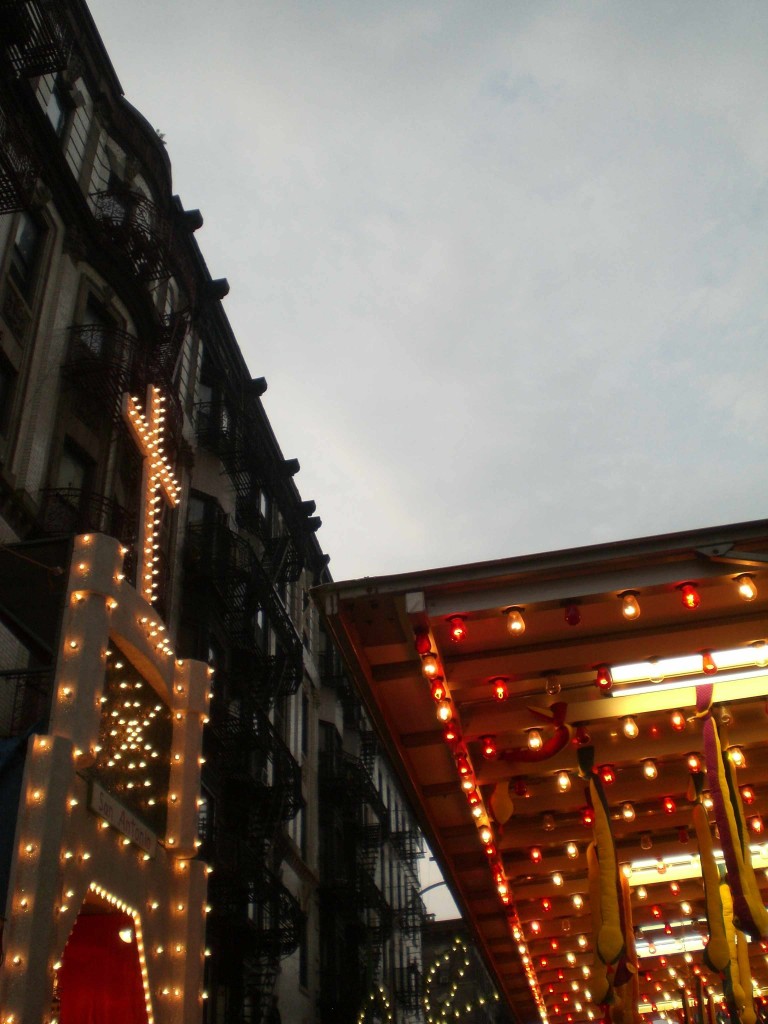
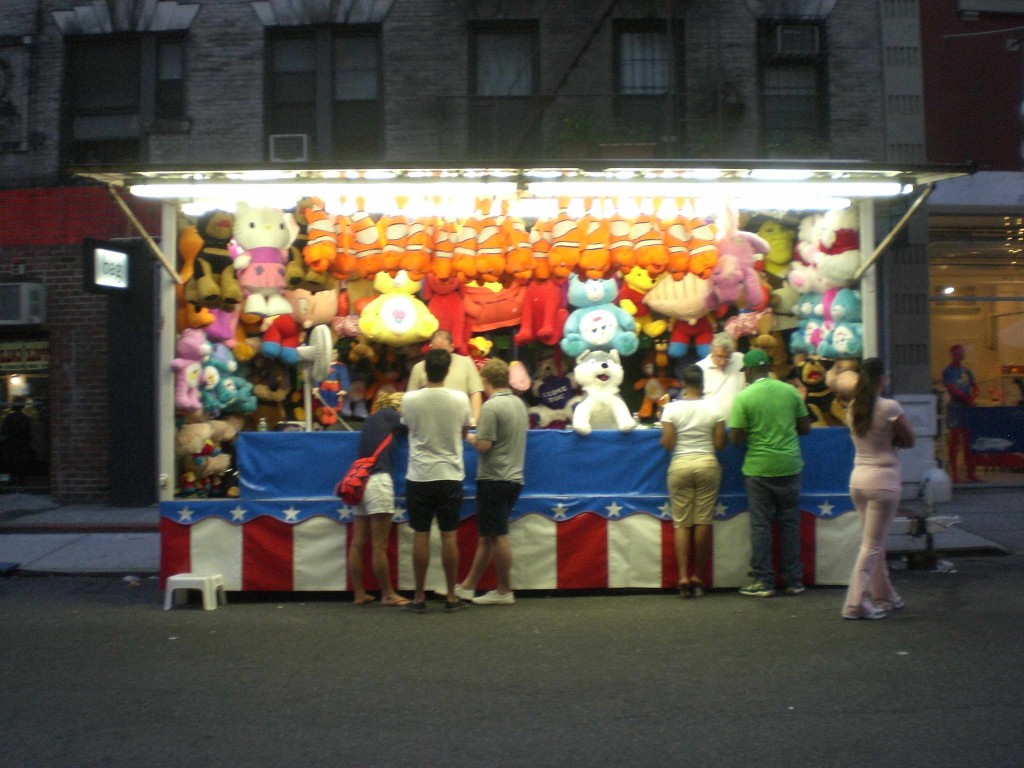
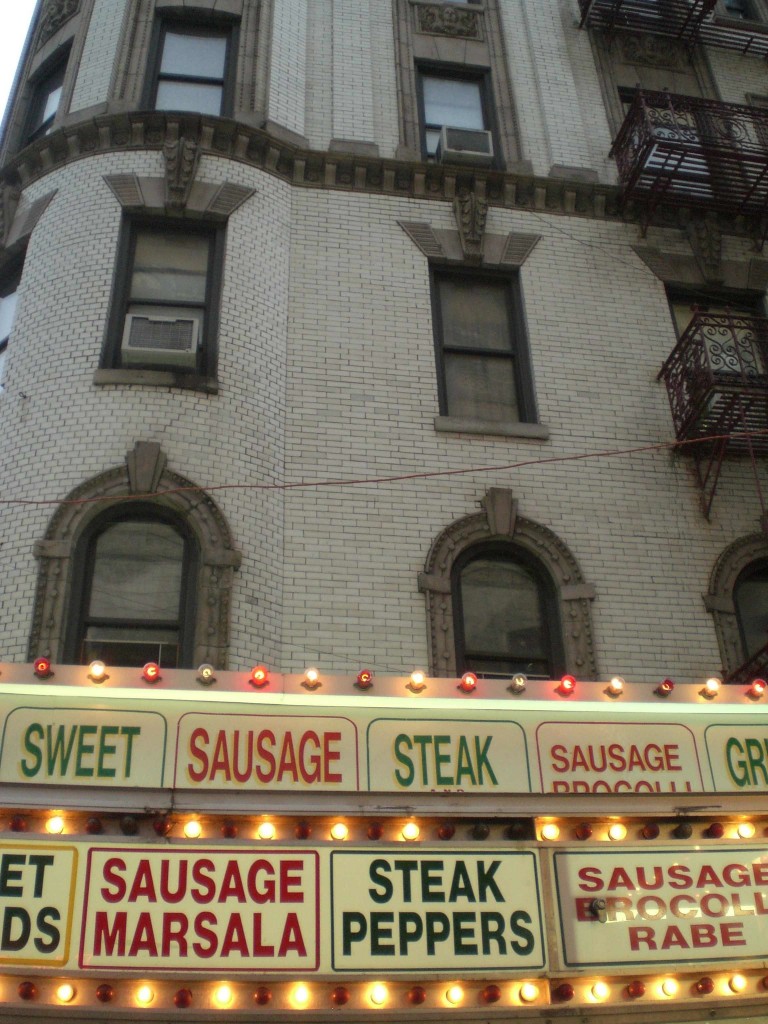
And then it’s summer again. Somehow it catches me by surprise every year. It always feels sudden, even when the weather has been circling around the inevitable conclusion for weeks, as if sighing and giving me time to get acclimated. Yesterday, a long and aimless walk through intermittent rain, a surprise eye-candy carnival, and a lobster roll on 7th Street. Today the Laundromat felt like it was about 90 degrees (the owners insist on advertising “Air Conditioning” on the window, though they haven’t turned it on in years).