Uncategorized
I love the websites of little hotels and B&B’s. There’s something sweet about how uniformly lo-fi and ugly they are, all the scrappy bells and whistles of the early internet hurled at one page. It’s like they’re trying to seduce and repel you at the same time, but because you know what to expect when you go looking for somewhere to stay in midcoast Maine, figuring out their tortured navigation is just a reassuring part of the pre-vacation ritual. The photos of the rooms are almost always dimly lit and sketchy-looking, but somehow descriptions like “small and very charming room with emerald carpeting, dark wood wainscoting and trim, light wallpaper, and lace curtains” sound like the greatest thing ever. I mean, wainscoting! Added to the fact that these places have amazing names like “The Jeweled Turret Inn” and “Berry Manor,” promise things like “sherry on the terrace,” and mention their policies about pets and children in the same sentence, and I am totally sold.
In July, we’re staying in a place that promises breakfast specialties including sourdough gingerbread waffles. Apparently, the fireplace in the den “is said to have been built of rocks from every state in the Union at the time the house was constructed,” and “one can examine it for hours and not uncover every beautiful detail.” The innkeepers are “lighthouse aficionados”! Their website’s nav bar has a cameo and a tassle on it! I am so ready.
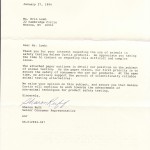
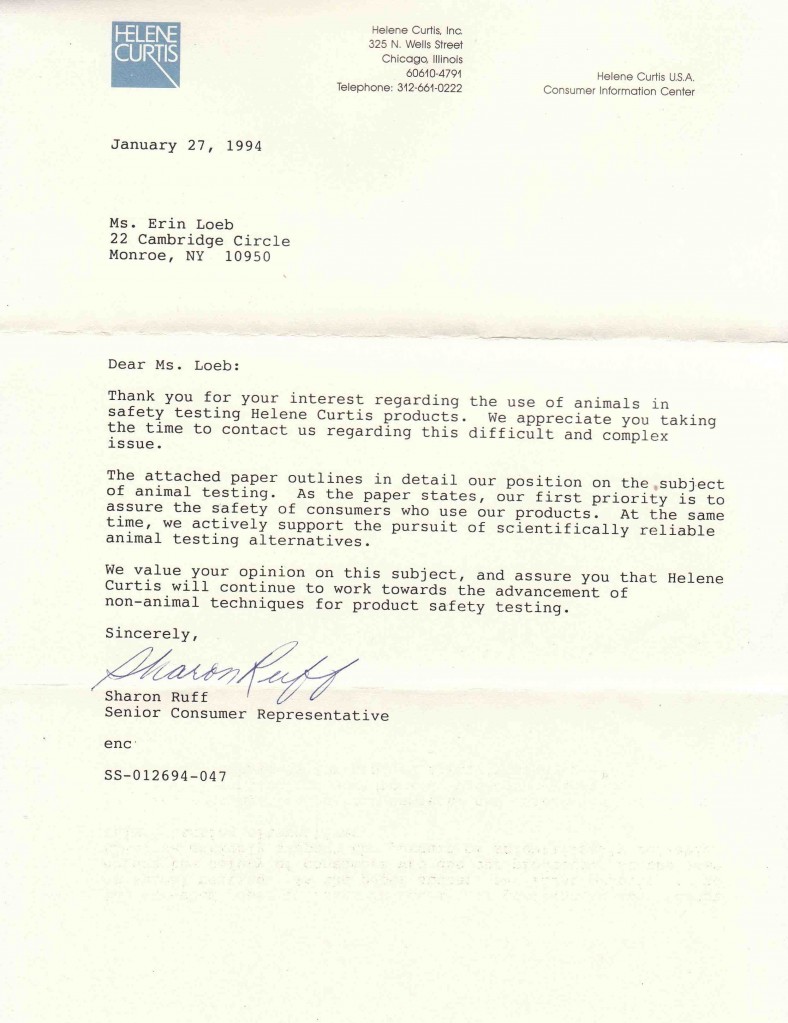
what i was doing in 1994
I was 12 years old. This was typed on a typewriter, and signed in ballpoint pen.
In this article about a Boston University graduation ceremony held 40 years after the fact, Peter Simon (photographer and member of the Class of 1970) points out the all around awesomeness of his generation. “Mr. Simon said that when he speaks about his photography around the country, students frequently say to him, ‘God, I wish I’d been alive and been part of your generation because it’s really boring now.’ He said he responds by saying: “But you have all this texting! You have cellphones! … And they say they’d give all that stuff away for the kind of experiences we had,” he said. “And I have to say, I agree.”
Here’s David Shields writing at The Millions, in rather calculating defense of his book Reality Hunger: “We live in a post-narrative, post-novel world. Plots are for dead people. Novelly novels exist, of course, and whenever I’m on a plane, it’s all I see everyone reading, but they function for us as nostalgia: when we read traditional novels, we get to pretend that life is still coherent.” Argh. The idea that his “literary collages” are all that can authentically exist today is as tired and transparent as the idea that novels offer the ultimate representation of human experience. I mean, argue away…but why pretend that one side has to prevail?
Jezebel’s Jenna Sauers attends a panel on Generation Y as the guest of 14-year-old fashion blogger Tavi Gevinson, and is privy to sweeping generalizations including, “The future is here and now and we are making it happen all around us!” and “Nobody says, ‘I got it on sale’ anymore. They say, ‘I got this on deal.’ That’s the language Gen Y is using” and “Blogs, blogs, blogs. Nobody really cares about objectivity anymore.” Afterwards, Sauers reports, she chatted with Gevinson about “Sassy magazine, and [Gevinson] showed off a 1992 issue of Details with Nirvana on the cover, which she had just acquired from Marisa Meltzer. Kurt Cobain looked particularly dejected in one of the photos inside. ‘Maybe someone just told him, ‘Robert Pattinson is going to play you in a movie one day,” deadpanned [Gevinson's] friend Nate Erickson.”
Cracked looks at six “supposedly ancient traditions that totally aren’t,” including Thanksgiving, Wicca, and The Pledge of Allegiance (“ancient” being pretty subjective here, of course).
The New York Review of Magazines looks at the past decade in magazines, inviting readers to “dip into nostalgia” as they look over some “memorable moments.” In a separate piece, the Review collects some quotes arguing for and against the continued relevance of print publications.
The Boise Weekly interviews NPR host Renee Montagne, who has been one of the main voices of All Things Considered for as long as I can remember. “It was always sort of wonderful not to be seen,” she says. “People would come up and say I didn’t think you looked like this … that you were taller….I can’t even say what I look like, but it’s not what people thought. People say that about everybody on NPR, but we’re losing that because today we’re a click away to see someone’s picture.”
In Splice Today, Noah Berlatsky wonders what Walter Benjamin et al would have thought about contemporary technology.
Finally, I love the photo of Dan Savage that goes with this profile of him in New York Magazine, in contrast to the one that’s on his Wikipedia page, and most other official places.
At the bagel place yesterday, there were monstrous Mother’s Day cupcake-muffin hybrids taking over much of the counter. They must have been corn muffins, the kind that are so dense they can do real damage to anything they’re thrown at. In general, eating them is not the greatest idea, but these ones were practically pulsing with brightness: Topped with about an inch-and a-half of bright pink frosting and even brighter pink sprinkles, with a big chalky candy heart (also pink, of course) stuck into the glop, crowned by a piece of gold foil that spelled out “Mother,” and a red and white plastic heart stuck into the whole thing that said, in gold script, something unintelligible and vaguely threatening like “Love the Mother.” Judging by the full tray, no one had bought one yet.
This is the same bagel place where women regularly ask for their bagels “scooped out,” and the guys behind the counter act like this is a normal request: for them to take an ice cream scoop and literally scoop out the bread part of the bagel, leaving a seeded shell that can be filled with low-fat cream cheese and whatever else. I’m sure this doesn’t only happen at this place; I bet “scooping out” (which sounds really gross, sort of accidentally sexual and also reminding me of Heidi Montag’s grotesque “back scooping” surgery) is some kind of newish bagel trend for women who can’t let themselves eat bagels but want to eat them anyway, sort of, and justify it by telling themselves they’re getting rid of the insidiously bagel-y part of the bagel. But watching them order it makes me feel a little uncomfortable, and sorry for them that they don’t seem to know their order makes them sound disordered rather than disciplined.
On Friday night Emily and Meredith and I looked for a semi-quiet bar for about an hour before settling on a slightly glorified West Village diner—the bar there was curved and columned, and surfaced with fake marble. The pastry case was glowing behind Emily as she talked, and the guy sitting next to me but just out of view seemed to be ordering a weird parade of dishes: some kind of ill-advised seafood entrée followed by pancakes, by the smell of it. There was something weirdly great about resigning ourselves to this place, choosing quiet and vodka tonics that would go on a check as $6.95 each over the bars we’d rather go on almost any other night.

I was reading the New Yorker on the subway the other day, and saw this ad. It took up a full page, and there was a full-color shot of Michael Phelps, dripping wet, on the facing page.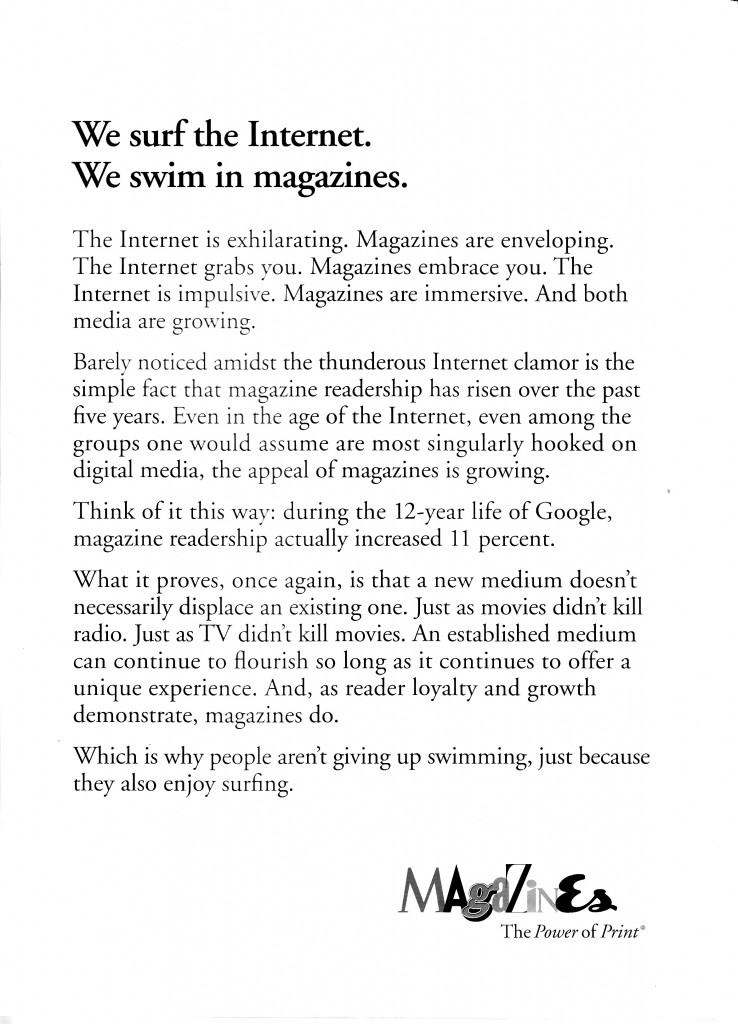
They’re really milking that swimming metaphor, huh? If anything, I’d say we “swim” in the Internet and “surf” magazines (regardless of the origins of those terms), and for better or worse, the Internet envelopes, immerses and embraces us in ways the ad tries to claim for print—but I admire the attempt to be generous about the medium that is in so many ways its competition. Still, it’s a pretty jarring plea for relevance, parked in the middle of the very thing whose relevance is in question.
So it was almost a little too perfect to hear, a day or two later, that Newsweek is up for sale (though maybe the ad foreshadowed it, since there’s no letter from that magazine in the little “Magazines: The Power of Print” logo at the bottom…and in that case, maybe the nine magazines represented will be the last ones standing?!). “As the American conversation has become harder to sum up in a single cover, that era seems to be ending,” the Times article on the impending sale pointed out, surprisingly directly. It went on to quote Charles Whitaker, research chairman in magazine journalism at the Northwestern University school of journalism: “The era of mass is over, in some respect. The newsweeklies, for so long, have tried to be all things to all people, and that’s just not going to cut it in this highly niche, politically polarized, media-stratified environment that we live in today.”
Newsweek’s editor, Jon Meacham, defended his belief in the importance of print to The Observer: “I’m not living in a fantasy 1965 world…This is not a Mad Men romanticism about the news magazine. I’m entirely realistic about our prospects for economic success and the possibilities of finding a consistent audience for our journalism.” At least that sounds a little more grounded than the smiling copy on the “Magazines” website: “We hope to dispel many commonly held myths about the state of our industry, and to share the exciting story of magazine advertising’s outstanding value, unmatched recall and vast cultural impact. Enjoy!”
This weekend’s Times Magazine story about how people who lost their spouses in the 2008 Sichuan earthquake are now getting remarried to each other (with some help from the Chinese government), reminded me of this pretty amazing 2004 piece about NYC firefighters who left their wives for 9/11 widows.
Virginia Heffernan contemplates the lost art of the analog datebook, with this caveat: “As a committed user of the BlackBerry, Kindle, MacBook Pro and World Wide Web, I rarely get nostalgic for print.” Conclusion? “You never know what you’re going to miss.”
The new book Stuff: Compulsive Hoarding and the Meaning of Things, points out that Andy Warhol was something of a hoarder. He “would periodically sweep everything — cash, artwork, apple cores — off his desk and into a cardboard box,” writes Peter D. Kramer in his review of the book. “He stored hundreds of these ‘time capsules.’”
Pop Matters is running a series of essays called “Retroactive Listening,” exploring how technology has changed the way we experience music. Here’s Emily Becker on the death of the record store, Jennifer Waits on college radio, and Jay Somerset on the death of AM radio.
In the New Statesman, Mark Fisher bemoans the lack of a “public space that could surprise or confound our understanding of ourselves,” and asks, “Where, today, is the equivalent of the Top of the Pops stage, which could suddenly be invaded by the unexpected?
In Reason, Andrew Potter (author of The Authenticity Hoax) looks at the tenth anniversary edition of Naomi Klein’s No Logo and wonders what we should make of it a decade on.
Hopefully, now copies of the White Pages will stop piling up on my doorstep!
what’s your flavor?
I’m used to perfume being marketed as something that should complement the essence of my being, but this commercial points out a missed opportunity: My marinade sauce should really capture my personality, too.
Who needs therapy? Lawry’s sauce understands you.
“I’m always exciting, and a little exotic.” Then sesame ginger is your sauce! “I’m earthy, with a splash of adventure.” Go for lime & chile! “I’m fun–and always fabulous.” Caribbean, baby! “I’m all heart, with a side of soul.” Italian Garlic! And a lobotomy!
Of course, anyone with a marinade personality is female.
Last year, upon watching a six-hour DVD of the BBC documentary, The Story of India, our creative director realized that his three-year-long suspicion was indeed correct–that India, a subcontinent grandly described as “a land of a one billion people, 400 languages, and 33 million gods” by writer, historian, and documentary narrator Michael Wood, would serve as an unrivaled location for an Anthropologie catalog.
Well, I’m glad that suspicion was finally confirmed.
the girl that i do not call must pack her bags and go home
New Zealand marketing itself via America’s Next Top Model…this is just confusing. It’s random enough that NZ was the destination this “cycle” (though it’s obvious now that it was result of some canny marketing), but seeing ads for New Zealand tourism pop up all over the place featuring the ANTM girls wearing those horrible rubber (or lycra or whatever) 80’s jumpsuits against a backdrop of picturesque mountains, and calling the country “the most gorgeous catwalk on earth,” makes my brain hurt.